Biden to dismantle Trump’s legacy

Crishelle Phoebe Yu ||

After the transfer of authority in the United States, the newly elected president, Joe Biden, is making rapid use of the unilateral powers he now possesses. Within hours after taking the oath of office at the Capitol, Biden signed the orders pivoting swiftly from his walled-down inauguration ceremony to the promulgation of his agenda. At the end of his first full week, he had provided 39 executive actions – orders, memoranda, and proclamations that could drastically shift the direction of American governance without any intervention by lawmakers in Congress.

Seeking to unify the global response to the coronavirus, Biden intends to regain the membership of the U.S. in the World Health Organization (WHO) immediately, which Trump formally withdrew in May 2020, claiming that China had put too much pressure on the agency. Biden included an order requiring everyone to wear a mask wherever they go.

“The World Health Organization plays a crucial role in the fight against the deadly COVID-19 pandemic as well as countless other threats to global health and health security,” Biden stated.

Biden also rejoined the Paris climate agreement, revoked the Keystone XL oil pipeline permit, and instructed the Environmental Protection Agency and the transportation department to reestablish fuel efficiency mandates as a part of overturning the environmental policies set by Trump.

To advance racial equality and eradicate systemic racism from federal programs and institutions, Biden released an executive order to help underserved populations. He stated that one of the priorities of his administration is to dismantle systemic racism.

           “The president-elect has promised to root out systemic racism from our institutions,” Domestic Policy Council director, Susan Rice, pointed out.
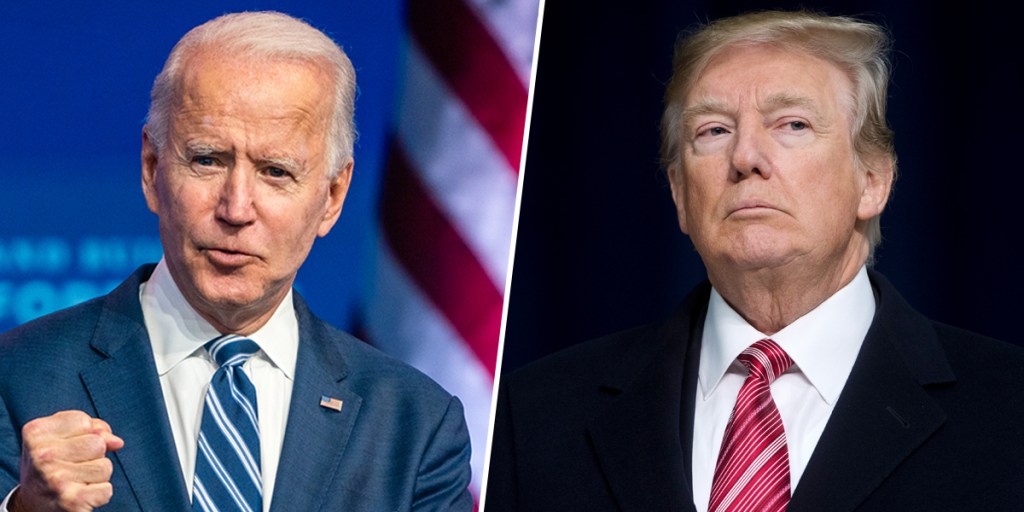
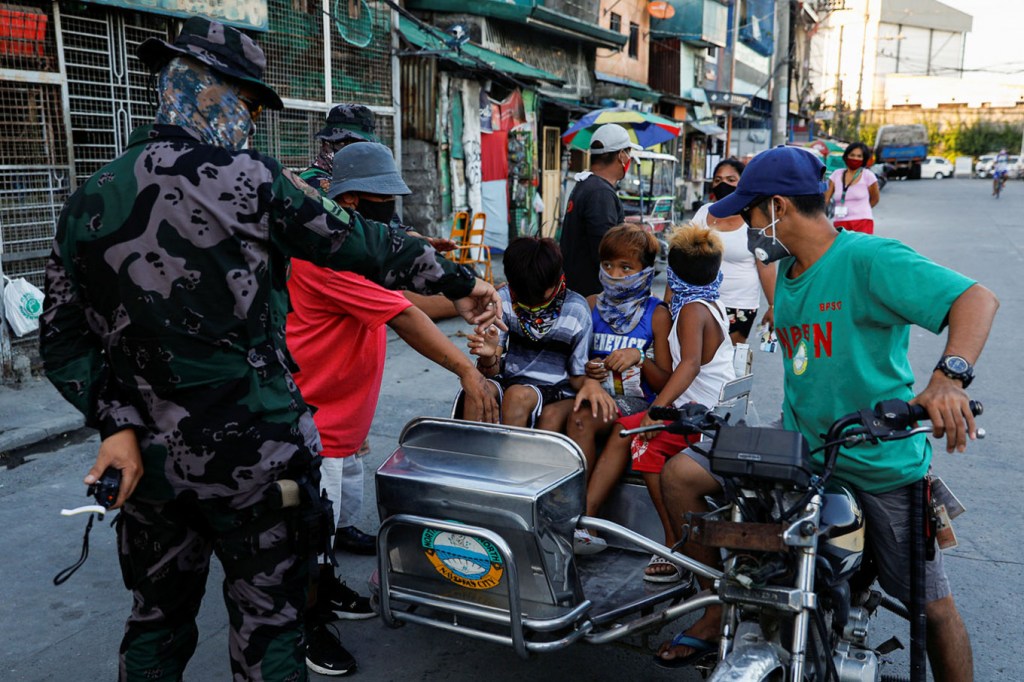
Photo Credit: NBC News

PSHS-EVC completes Wi-Fi project to ease distance learning

Aya Ecaldre ||

In line with the transition to online learning due to the COVID-19 pandemic, PSHS-EVC implemented a project on improving the campus’s internet connection. The new network now features 500 Mbps speed and improved Wi-Fi area coverage. 

This project was spearheaded by the school director, Erick John Marmol, in collaboration with the Management Information System (MIS) Coordinator, Lalaine Llose, and the Information Systems Analyst (ISA), John Paul Soledad. The project had been set to be implemented in the first quarter of 2020. However, due to the strict health protocols brought forth by the pandemic, the project had been delayed, resulting in the improved network to be launched later in January 2021.

Wi-Fi networks located in each building are connected to the Campus Server Room through a fiber optic cable. Before, the Wi-Fi connection was only accessible from inside the employees’ buildings. Now, the Wi-Fi is open to everyone in the admin building, hallways, gym, dormitory, and canteen. Currently, the CReST and the Learning Resource buildings are not yet connected. However, they are set to be included in the cabling project for 2021. 

All students, faculty, and staff will have free access to the Wi-Fi network through their log-in accounts. Guests and visitors may also have access as per request. Although there are still weak spots such as the open field and park, the network is still supposedly strong enough to be used in school-related tasks. As of now, the bandwidth of the network has no limit. However, when face to face classes resume, a limit on the upload and download will be set to regulate the internet usage. 

Llose stressed the need for a stable internet connection in conducting online classes. She emphasized,

“One of the parameters to successfully conduct an online class is a reliable internet connection. With the Structured Network Cabling and Wi-Fi Network Project on the campus, this is made possible.”

IATF-EID eases age restrictions in MGCQ areas

Louella Mae A. Sas ||

Starting from February 1, 2021, the Inter-Agency Task Force on Emerging Infectious Diseases (IATF-EID) will ease the age restrictions in areas placed under Modified General Community Quarantine (MGCQ), which the Presidential spokesman, Harry Roque, announced last January 22. From the previous age restriction of 15 to 65 years old, the agency will now allow children aged 10 to 14 years old to go outside their residences. However, they can only leave their homes if accompanied by their parents.

For the areas still under General Community Quarantine (GCQ), the respective local governments would have to decide whether they would also adopt the eased restrictions. Moreover, the eased age-based restrictions mean that persons below 10 years old and older than 65 years old are still not allowed to go out and are required to stay home at all times except for essential activities.

The Department of Trade and Industry (DTI) and the National Economic Development Authority (NEDA) were the offices that proposed to ease the age restrictions to help stimulate economic activity. They explained that Filipino children have already been staying in their homes for ten months and that allowing them to leave their houses is good for their physical, social, and mental health. 

DTI Secretary Ramon Lopez also stated that, based on their conducted surveys, business revenues could potentially double or triple once more people would be allowed to go outside. He said that this would prevent the closure of enterprises and job loss. It is also a way of helping businesses survive during the pandemic since economic activities would be re-stimulated.

Not easing restrictions would result in further economic deterioration; thus, the government needs to balance opening the economy and controlling the spread of the virus. The task force is then reassuring the public that health protocols would be strictly followed. 

“As long as we continue to implement and comply with the minimum public health standards, kahit anong age ang lumalabas as long as compliant tayo, we are protected,”

DOH spokesperson Ma. Rosario Vergeire stated.

Moreover, the agency clarified that allowing children to go out is not the same as letting them attend face-to-face classes since they differ in nature, intensity, and proximity.

Photo Credit: The Jakarta Post

E. Visayas reports first ASF case

Louella Mae Sas ||

The Department of Agriculture (DA) announced the first case of African swine fever (ASF) in Eastern Visayas last January 15, 2021. Blood samples taken from hogs in Abuyog, Leyte have tested positive for ASF. The virus affected the backyard farms of Barangay Can-aporong and Bunga where unusual swine mortalities were reported during the latter part of 2020.

It was on January 6 when the DA launched an investigation and took semen samples from seven pigs, four of which resulted positive according to the antigen detection rapid test conducted. For confirmatory testing, they also sent the samples to the Animal Disease Diagnosis and Reference Laboratory of the Department of Agriculture’s Bureau of Animal Industry (BAI) in Manila, which confirmed the result on January 12. 

It was agreed in the coordination meeting of the Department of Agriculture and the local government unit that control measures should immediately be implemented to control the movements of swine and hogs. According to DA Regional Director Angel Enriquez, disease control measures such as depopulation and proper disposal of the affected hogs, inventory of hogs in the identified areas, enforcement of strict border control, and disease surveillance and samplings, including in nearby villages, were implemented. 

All hogs within a 500-meter radius from an infected swine would be culled, and the checkpoints would be operated by the Philippine National Police and the Provincial Agriculture and Veterinary Office. The local government has also banned the entry of all vehicles carrying pigs and pork meat.

According to the DA, it is not yet clear how the hogs have acquired the virus; however, they are examining two possible reasons behind it. DA Information Officer Francis Rosaroso said,

“One could be due to boars service providers as most of the affected pigs were adult female swine and second, due to swill feeding or left-over food, which we discourage.”

PSHS-EVC celebrates Christmas virtually

Louella Mae A. Sas ||

To welcome the Christmas season, the Philippine Science High School – Eastern Visayas Campus (PSHS-EVC), in coordination with the Student Alliance, held a two-week school-wide virtual event, the “Pisay Pamasko Experience”. With the goal of bringing the EVC community closer, the festivities were composed of three different sessions with various games and talks from speakers including Pisay alumni and scholars. The events were live-streamed on the EVC Direct page.

The first session which was the “STEMatagingting na Pasko: STEM Career Testimonials” was held last November 27, 2020. Three EVC Alumni were invited as speakers for this event, namely, Mr. Mark H. Robin, a Senior Software Engineer – Inspire Team, Arch. Junelle B. Barcena, a Creative Arts Specialist I – Philippine Statistical Research and Training Institute, and Engr. Ma. Roselle C. Portula, a Quality Assurance Manager – Mondelez International. The speakers shared their past experiences as scholars in Pisay, their career choices, and what to expect after we graduate in Pisay. They gave a lot of advice on how to choose the best career for the PSHS scholars.

The second session which was the “Kwentuhan sa Paskong Kwarantin” was held last November 28, 2020. Scholars from different batches were chosen to be speakers in this event, namely: Reese Latonio, Marifel Balbarona, Nicole Erroba, Ronn Opina, and a freshman, Samantha Macabit. The speakers shared their quarantine experiences and the seniors also shared tips related to school for the younger scholars.

In line with the “Pisay Pamasko Experience”, the SA also held competitions such as the “Pa-Mask Ko: A Face Mask and Face Shield Design Competition” in which the participants designed their face mask or face shield in adherence to the theme: “QuaranFeels: How do you feel under this quarantine?” and “Pisay Tiktok Competition” wherein the participants were free to do whatever they want; as long as their TikToks were Pisay related which would be judged based on the idea, creativity, presentation, resourcefulness and audience impact.

To formally conclude the event, the third and last session, the “pa-MASK-orisyo: PISAY Christmas Culmination Program” was held last December 18, 2020. The director, Sir Erick John Marmol, gave a closing speech and the winners from the icebreaker games during the sessions, TikTok competition and Pa-Mask Ko competition were announced.

PSHS implements new admission system, RACE

Crishelle Phoebe Yu ||

Photo Credit: PSHS System Page

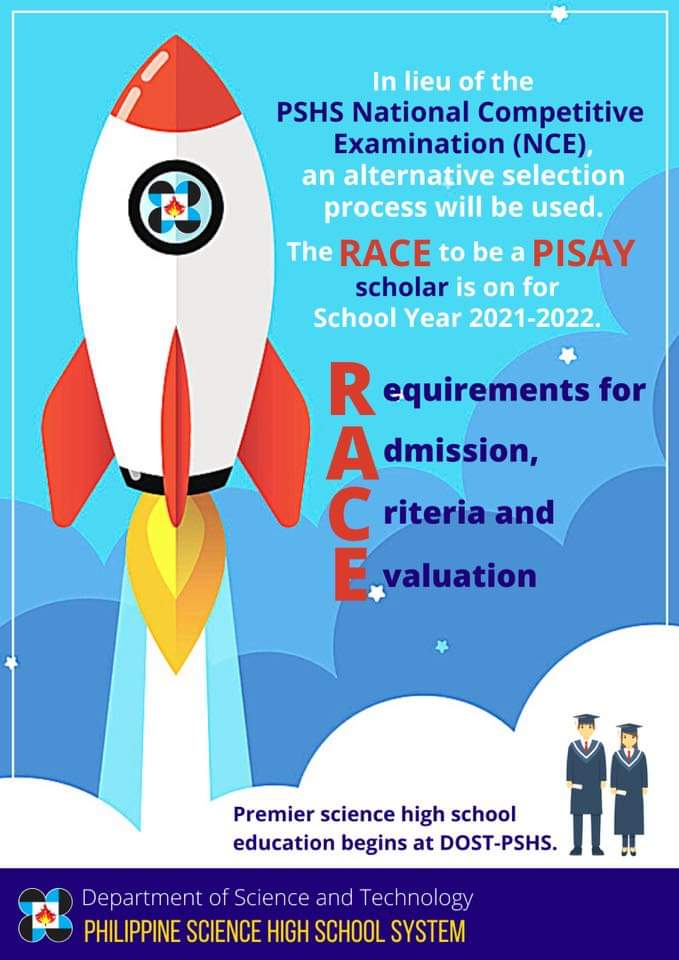
Due to the increase of COVID-19 cases in the Philippines preventing physical entrance examinations, the Philippine Science High School System (PSHSS) has implemented a new method of admitting students for the school year 2021-2022. In lieu of the PSHS National Competitive Examination (NCE), the system has decided to carry out a new alternative selection entitled Requirements for Admission, Criteria, and Evaluation or RACE.

The selection procedure shall be done in two stages. The first stage will determine the student’s predicted NCE grade (PNG) based on their final grades in Mathematics and Science in 5th grade. The second stage will be based on the student’s writing skills through making an essay and the applicant’s academic rank at the end of 5th grade.

The applicants will be ranked from highest to the lowest based on their final score and the top 240 will be considered as principal qualifiers for PSHS-MC (Main Campus). Depending on the decision of the system, the top 90 or 120 applicants in regional ranking will be considered principal qualifiers for their chosen regional campus.

SAEYLS: Reshaping the environment

Crishelle Phoebe Yu ||

With aims of honing leadership skills and creating an environmentally conscious generation, Sri Aman Environmental & English Youth Leadership Summit held an international competition last August 4-5, 2020. Participating schools for this year’s summit included delegates from Thailand, Indonesia, and the Philippines.

The goal of SAEYLS is to unearth, hone and develop the leadership skills and abilities of the youth and to enable them to lead the global community of tomorrow to be highly environmental-conscious as well as embrace environmental-friendly lifestyles. They believe that as leaders of tomorrow, the youth can definitely bring about this significant change in the mindset of the global community, and ultimately, improve the quality of life.

Kendra Osias, a delegate from Philippine Science High School – Eastern Visayas Campus, pointed out that the event was very educational, fun, and interesting.

“It was fun! A little pressure, yeah, because it was an international competition, but mostly fun! It was also super educational and interesting because there were so many different cultures that led to different writing styles, topics, etc. I also had fun writing poetry again, because it’s something I haven’t done in a while.”

, she stated.

Learning Crisis: PSHS students face distance learning

Crishelle Phoebe Yu ||

No long lines at the school gates. No visible first-day school jitters. Following the Philippine Science High School System’s (PSHSS) directive to delay face-to-face classes until measures set by the Inter-Agency Task Force on Emerging Infectious Diseases (IATF-EID) allow it, the PSHSS decided to shift to distance learning for this academic year. Last September 7, 2020, the school system opened classes for SY 2020-2021. With this, Batch 2026 is set to encounter distance or online learning in their first year of high school.

A student from Batch 2026 stated that one thing is certain – there are a lot of factors affecting this mode of learning.

“Personally, I can say that I’m doing fine. I have quite adapted to this new mode of learning.  Sadly, I have to say that it’s quite challenging to be on online learning with a lot of factors affecting it such as slow internet connection. Although, it would be better if we would be back to our face-to-face classes. Overall, it’s interesting yet challenging but I know I can withstand this.”

, she/they stressed.

With this, PSHSS has conducted an academic break for the students from October 30, 2020 to November 6, 2020. This is in consideration for the students’ welfare and mental health. 

Another freshman also added, “I am constantly engulfed in despair-inducing experiences that lead to my consecutive anxiety attacks and the thought of just—giving up. I hope this changes in the near future, and I also hope that this crisis will soon end.”

For Eastern Visayas Campus, the students attended mental health orientations held through Google Meet, Zoom, or Facebook Live that can help with coping. By addressing mental health, students will begin their knowledge of the various challenges they or their peers may face at the present moment or at some point throughout their careers.

“I wish I could interact a bit more with my new classmates and meet them already. I also want to enjoy the Pisay life but because of the pandemic we’re under, it’s still not possible. But all in all, it’s great and I’m happy as a freshie!”

, another student said.

2021 college entrance tests canceled

Louella Mae Sas ||

Due to the health and safety protocols brought by the coronavirus pandemic, colleges and universities were forced to cancel their usual College Entrance Tests (CETs). These tests are the yearly examinations conducted to determine who are worthy and fit to enroll in their institution. These colleges would not be able to conduct these exams since it would be a major risk to gather thousands of students to take the test. Thus, each institution has weighed other options on what system would be best to follow for the 2020-2021 admissions catering to the pandemic situation.

The first university to announce its new admission system was the University of Santo Tomas (UST). Last August, they declared that they would not be holding the UST Entrance Test (USTET) for the college applicants this Academic Year 2020-2021 due to the restrictions brought by the pandemic. Instead of USTET, they will be holding the UST Admission Rating (USTAR) which would be based largely on the applicants’ record and academic performance.

The Ateneo de Manila University, on the other hand, declared at the end of October that their college application would open on September 1, 2020, and would end on January 2021. The university has decided to diminish its usual Ateneo College Entrance Test (ACET) and follow its new system of application which is completely online to cater to the current pandemic. The admission will be based on students’ academic and non-academic performance from Grades 9, 10, and 11, on the batch rankings, and also recommendation letters from their teachers, extracurricular activities, disciplinary record, and their admission essay.

Also last October 2020, UP revealed that there were five options they were eyeing on. These options were: (a) a paper-and-pen administration of the usual University of the Philippines College Admission Test (UPCAT) that would strictly follow the proper protocols; (2) and online examination, (3) a mix of online and paper-and-pen, (4) a system that would be based on their previous records and performance to determine their University Predicted Grade (UPG), and (5) a moratorium on the admissions. UP has already set the application period for first-year students to start this January 7, 2021, while the admission system is still undergoing modification. Lastly, for the college applicants of the De La Salle University, they would also not take the usual DLSU College Admission Test (DCAT). Their admission would be based instead on their academic record in high school, letters of recommendation, class rank, and other information to be filled in the application form. The application period started last November 23, 2020, and will end on February 15, 2021. Application results will be released on the 3rd week of April 2021.

PSHS-EVC holds Batch 2020 virtual graduation

Johanna Lindsey Macababbad ||

Philippine Science High School – Eastern Visayas Campus (PSHS-EVC) held the “PAGPUPUGAY: The Virtual Recognition of Batch Kulawi at ng Ikadalawampu’t Isang Palatuntunan ng Pagtatapos” via a pre-recorded video on Facebook last August 8, 2020.

Batch 2020 of PSHS-EVC, composed of 86 graduates, is known as Kulawi (means “to see”) in which the name expresses their eagerness to learn, explore, and experience what the world may bring to them beyond high school. 

Patricia Joy Abarquez, who graduated with high honors, stressed in her speech that after six years, less than for some, of hard work, struggles, and happiness, they should continue on their journey using the skills they acquired during their time in PSHS-EVC.

“Tayo ay mga iskolar na may mahalagang papel na dapat gampanan para sa ating bayan. Gamitin natin ang lahat ng ating natutunan upang mahamon at mabago ang sirang sistemang ating nakagisnan at nang sa gayon ay magabayan natin ang ating bayan sa daan patungo sa kaunlaran”

, Abarquez stated.

The graduation video was available on Facebook until August 25 and was deleted after to protect the privacy of the students as requested by them, their parents, and the school.