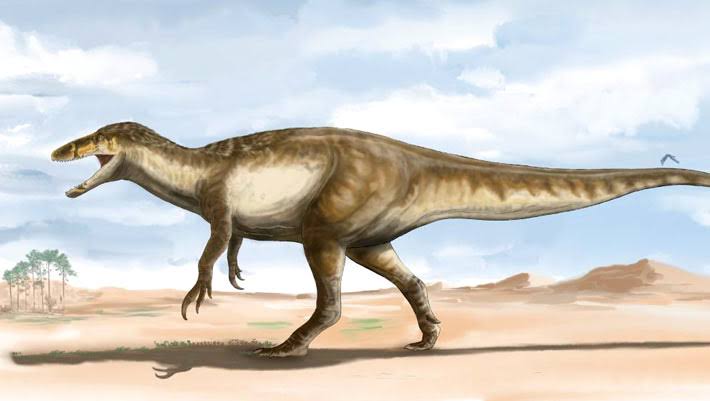
𝑴𝒂𝒊𝒑 𝒎𝒂𝒄𝒓𝒐𝒕𝒉𝒐𝒓𝒂𝒙: World’s Largest Raptor Dinosaur

by: Clarence Jude Tabinas || Photo Credit: New Atlas

Argentinian paleontologists have discovered the remains of Maip macrothorax, the world’s largest raptor dinosaur, at the Chorrillo Formation in Santa Cruz Province, Argentina. Its length ranged between 9 to 10 meters which was longer than other “megaraptors,” whose lengths ranged between 6 to 8 meters. As for its weight, analyses revealed that it weighed about 5 tons, twice that of a rhinoceros.

Its generic name, Maip, comes from Aonikenk mythology, which is known to be an evil entity that represents “the shadow of death” that “kills with cold wind.” Its specific name is macrothorax—macro coming from the Greek word for makrós, which means big, and thorax, the Latin word for chest, in reference to the creature’s wide thoracic cavity, which is estimated to be more than 1.2 meters wide.

During the early years when they still roamed the Earth, they inhabited the continents Asia, Australia, and South America. They had the body structure of elongated skulls, 60 strong teeth that were 8-shaped in cross-section, and long and powerful arms with large sharp claws.

Although megaraptors were not as big and powerful as the Tyrannosaurus rex, they were a force to be reckoned with. These creatures mainly fed on smaller dinosaurs. With their long, slender legs and light body, catching up to their prey was not difficult. They would grab their meal and rip it apart using their strong arms and deadly claws measuring up to 14 inches. Based on the study conducted by paleontologists, the species ruled Argentina about 70 million years ago during the Cretaceous period. 

According to scientists, the extinction of Carcharodontosauridae dinosaurs about 94 million years ago may be the primary reason why these raptors grew to such sizes. As these dinosaurs were the apex predators on the southern continents, their extinction greatly affected the food chain, causing Maip macrothorax to evolve to fill the spot of the apex predator.

As of today, the remains of Maip macrothorax are safely kept at the Bernardino Rivadavia Natural Sciences Argentine Museum in Buenos Aires. As it was well preserved upon its discovery, it provides plenty of information into the anatomy of dinosaurs and their constitution, such as muscles and ligaments.

Even though reports about the discovery were published last April 26, 2022, the discovery comes from way back in 2019, just before the restrictions brought about by COVID-19 were enforced. This coming 2023, the team plans to return to the site in hopes of finding more remains that could help further advance their study.
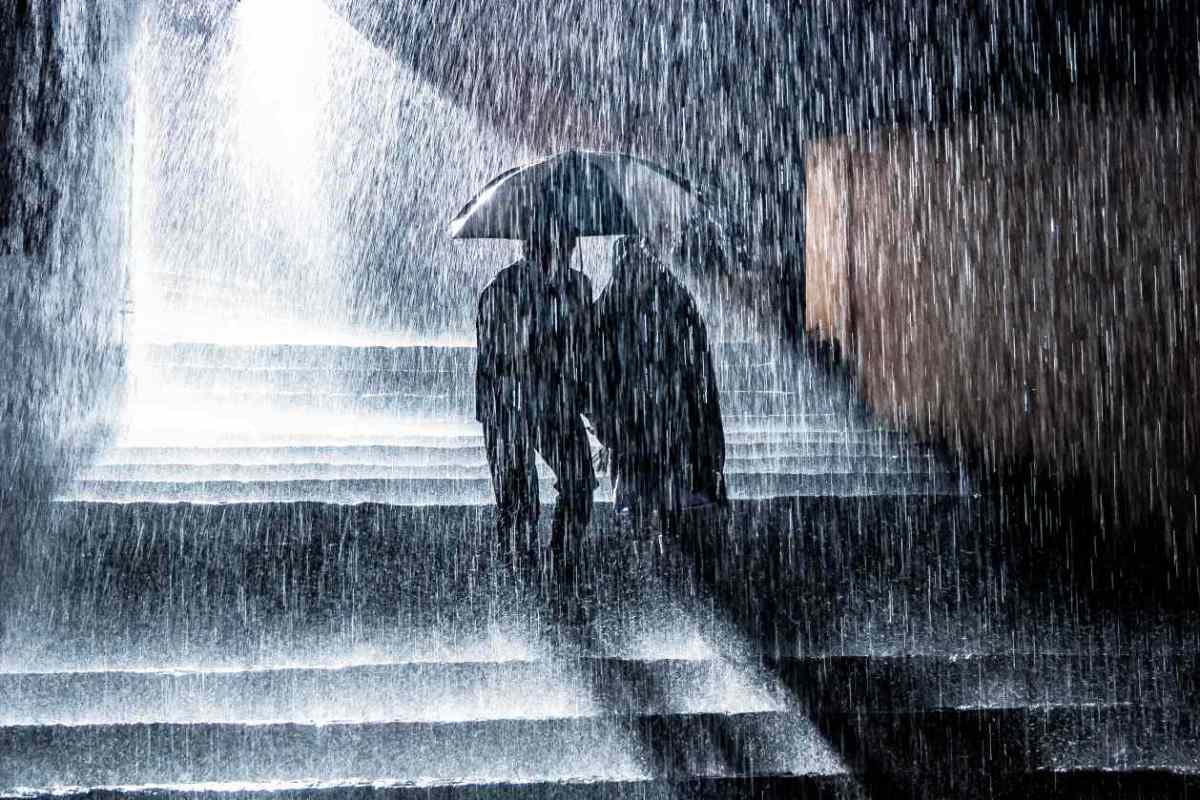

A rainy welcome to December

by: Nathaniel Dela Torre || Photo Credit: fitopardo.com/Moment Open/Getty Images

Heavy rain and possible thunderstorms are expected to greet us as we enter the Christmas season, as reported by the Philippine Atmospheric, Geophysical and Astronomical Services Administration’s (PAGASA) daily weather forecasts. 

Cloudy skies, moderate to heavy rain, and thunderstorms are forecasted to occur in most areas of the country. Some of these areas include Northern Luzon, Eastern Visayas, Palawan, Davao Regions of Mindanao, and many others.

Three weather systems will continue to bring rain to the country. The first is the Intertropical Convergence Zone (ITCZ), wherein trade winds from both the northern and southern hemispheres meet, causing thunderstorms to occur. Another are the easterlies, which are hot winds flowing from the Pacific Ocean.  The last weather system affecting the country this month is the shear line, wherein the cold trade winds and the hot easterlies meet, also resulting in thunderstorms. 

All three weather systems cause rainfall or thunderstorms to occur. The ITCZ will affect most parts of Visayas and Mindanao, the shear line will take effect on parts of Northern Luzon, and lastly, easterlies will strike the eastern portions of the country.

One to two storms are expected to enter the Philippine Area of Responsibility (PAR) for the month of December. The typhoons are to be named Rosal and Samuel, respectively. As of December 5, 2022, no Low-Pressure Areas (LPA) or typhoons are being monitored by the agency within or outside of the PAR.

Gale Warnings were also raised on Northern Luzon, specifically Batanes, Cagayan, Babuyan Islands, and Ilocos Norte. Obet Badrina, a weather specialist from PAGASA, stated, “Inaasahan pa rin po natin na magiging maalon yung karagatan sa may hilagang baybayin po ng Hilagang Luzon … dulot ng pag-iral po ng Northeast Monsoon o ang hanging amihan. Kaya iwasan po muna nating pumalaot dito po sa lugar na ito ng ating bansa.”

[We are expecting wavy seas in the northern coasts of Northern Luzon … due to the Northeast Monsoon. With this, let us avoid sailing in these areas of the country.]

PAGASA continues to warn the citizens living in areas experiencing rainfalls to be careful of landslides and flash floods. These two are the deadliest weather-related hazards in the Philippines. With increased amounts of precipitation, it is expected that these hazards will also occur.

Climate Change: What did it do to 2022?

by: Alexis Celine Morabe || Photo Credit: Getty Images/Forbes

Climate change is a story we’ve all heard and a tune we can sing in harmony. Scientists have warned us of the consequences of it, yet we never seem to fail to look the other way. Although 2022 may not have been the most disastrous year of severe forecasts, we are indisputably witnessing the effects of climate change and the impacts of one natural catastrophe after another. According to the UN Secretary-General, the world is in a state of climate emergency—they dub it “a code red for humanity.” 

A code red for humanity sounds intimidating. It doesn’t mean that lunar eclipses would wake zombies nor would any siren-infested tsunamis grace the world. It simply means that the Earth is becoming so hot that temperatures in about a decade will almost likely exceed an extent of warming that international leaders have aimed to avoid. 

Cities across the globe have been experiencing too-hot summers and breaking temperature records left and right, and with schools reestablishing face-to-face classes, this can prove to be an obstacle to learning. 

Floods, forest fires, storms, tornadoes, and many more have wreaked havoc on many schools. A four-day break can turn into a month in a blink of an eye because of damage done to buildings, classrooms, books, and other materials which become beyond use. Students severely affected by these calamities may find it difficult to even think about school when they have to worry about their own survival. Why worry about the canceled play when you don’t even have a house? Why worry about your drowned project when you’ve lost a family member? Why worry about graduating from school when you don’t even have enough money to buy sardines? 

The consequences of climate change are alarming. Countless ordinances and programs have been established to help lessen the effects of climate change, but these alone wouldn’t be enough. What could you do, dear reader? A few ways everyone can help would be to invest in renewable energy, reduce plastic use, recycle, and raise awareness. These are keys to helping not only the Earth and community, but education as well.

Two-faced Beauty of Artificial Intelligence

by Kyle Andrew Abello || Photo Credit: Simplilearn

     â€œOK, Google, open the-science-net.com.”

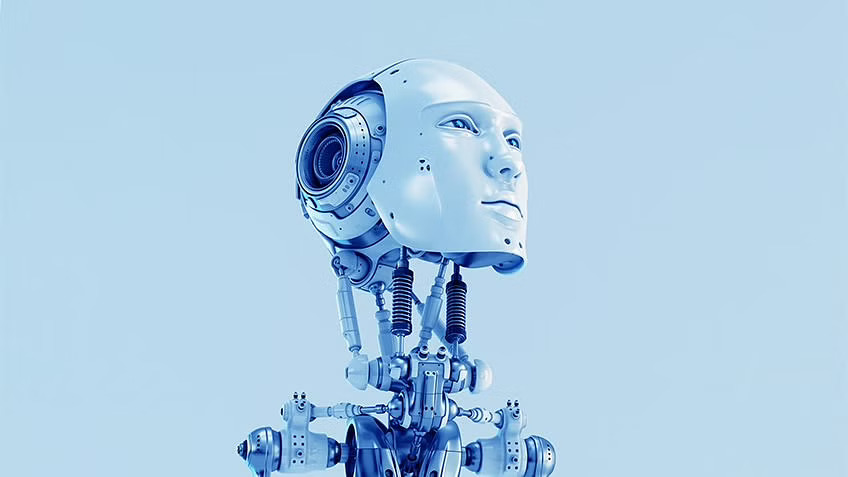
     Anyone who owns a device, whether it be a smartphone or a laptop, has likely already come across or is familiar with the likes of voice recognition interfaces, such as Google Assistant, Cortana, Siri, or Alexa. One might consider them as the voices of the device, while others might see them as the beings that man the device they’re using. Either way, these are digital assistants powered by Artificial Intelligence.

     â€œCortana, what is Artificial Intelligence?”

     According to Britannica, Artificial Intelligence, also known as AI, is the ability of a digital computer or computer-controlled robot to perform tasks usually associated with intelligent beings like humans. The interfaces mentioned, such as Google Assistant, are just a part of what AI could be, as it could also be in the form of computer-controlled robots that deliver parcels, food, and more.

     AI serves to be a powerful tool society could use for numerous purposes. In theory, it is a fascinating thing that can significantly benefit humanity. While there are advantages to utilizing AI, disadvantages also exist despite its sheer beauty.

     â€œSiri, what are the pros and cons of AI?”

     The first obvious advantage of AI is its convenience. As mentioned, it could act as a digital assistant. Additionally, the simulations of an AI can also run 24/7, eliminating the need for workers to work long hours as it could even help with household chores. Furthermore, repetitive jobs like proofreading can be done by AI. It is also useful in minimizing human errors in tasks, solving complex problems, taking the risks for humans, and more. Essentially, AI can be advantageous for humanity in terms of convenience and assistance to mankind.

     However, despite its glamor, AI also has its disadvantages. The first and most apparent drawback would be its high cost of creation. In line with its value, it requires adequate funds for the hardware, software, and maintenance of these systems and devices. Another downside would be the effect it would have on people, making them more dependent on these devices to fulfill their tasks. Unemployment is also a heavy drawback for AI as millions would be left jobless once it replaces servers, cleaners, and others. As a matter of fact, people are so worried about AI replacing humans and taking over the world that even the late Stephen Hawking said, “I fear that AI may replace humans altogether.”

     AI certainly has its positive and negative sides. It is inevitable that the advancement in technology would continue in the future, so AI will be more integrated into society as time progresses. As AI is becoming an integral part of technology, society is taking steps to minimize the effects of its drawbacks. After all, these interfaces should benefit humanity, not damage it. 

    “Alexa, take me back to my homepage.”

DART: Redirecting asteroids for planetary defense

by Nathaniel Dela Torre || Photo Credit: NASA/Johns Hopkins/Handout via REUTERS

On the 26th of September, at 7:14 p.m. Eastern Daylight Time, National Aeronautics and Space Administration’s (NASA) Double Asteroid Redirection Test (DART) successfully made its impact with the asteroid Dimorphos as a part of NASA’s overall planetary defense strategy. This event turned out to be the first-ever time NASA had been able to change the motion of a celestial object and the first time it had ever demonstrated asteroid deflection technology.

NASA has deemed Earth as ‘no longer powerless’ against potential earth-bound comets and asteroids. DART serves as NASA’s first demonstration of kinetic impact as a part of its overall planetary defense strategy. This demonstration was an opportunity to test whether kinetic impact is viable in mitigating an earth-bound asteroid or comet (NASA, 2022).

As mentioned, the mission made use of the kinetic impact technique. According to NASA (2015), kinetic impaction involves sending one or more large, high-speed spacecraft into the path of an approaching near-earth object. In this case, the smaller DART spacecraft targeted Dimorphos, a moonlet of a larger asteroid named Didymos, in hopes of redirecting its orbit. 

Before the collision, Dimorphos takes around 11 hours and 55 minutes to orbit its larger parent asteroid, Didymos. The mission aimed to alter the smaller asteroid’s orbit by at least 73 seconds or more. It is important to note that neither asteroid poses a threat to Earth.

On November 23, 2021, the SpaceX Falcon 9 rocket was launched, and carrying along with it was the DART spacecraft. The launch took place at the Space Launch Complex 4E, Vandenberg Space Force Base in California. The DART spacecraft itself is low-cost, with dimensions of roughly 1.8 meters in width, 1.9 meters in length, and 2.6 meters in height.

On September 11, a spacecraft was ejected from DART. This spacecraft is called Light Italian CubeSat for Imaging Asteroids (LICIACube), and its primary purpose was to capture photos of the collision up close. The impact was successfully made on the 26th of September the following year, 10 months after the initial launch. Two days after the collision, on September 28, LICIACube uploaded its first images of the event. They will be used to add relevant information about the generated plume. 

After two weeks of looking into the results of the mission, NASA held a media brief that occurred on Tuesday, October 11. The agency revealed that the DART mission has successfully altered Dimorphos’ orbit by 32 minutes, shortening the asteroid’s orbit to 11 hours and 23 minutes. DART’s investigation team will continue to look into the images produced by LICIACube and other ground-based observatories.

DART’s success proves to be another leap for mankind as we prepare to defend ourselves from potential disasters. This first step towards planetary defense opens up more possibilities and more potential missions in the near future.

Fall Equinox: Embracing Autumn in a Tropical Country

by David Roberts || Photo Credit: Matt Cardy/Getty Images

“Autumn leaves falling down like pieces into place, and I can picture it after all these days”

– Taylor Swift, All Too Well (Taylor’s Version)

So the season of pumpkin spice lattes and crunched golden leaves is fast approaching, huh? Although we live in the tropics, that should not stop us from enjoying the beauty of the autumnal aesthetic. With this year’s fall equinox fast approaching, here are a few facts and folklore concerning this phenomenon.

The fall equinox takes place on September 23rd, marking the official start of autumn. However, that is only applicable in the Northern Hemisphere. For the Southern Hemisphere, it actually occurs in March. During the autumnal equinox, the sun shines directly above the equator from the North Pole, causing the hours of day and night to be equal in length. The word “equinox,” like solstice, is derived from the Latin roots “aequus” meaning “equal,” and “nox” meaning “night.”

This equinox also denotes the point at which nights begin to outnumber the days in the Northern Hemisphere, indicating less sunlight and a much colder temperature. No more beach days and tans, as scarves and thick coats will be your best friends. Moreover, the autumn season lasts until the winter solstice—the world’s shortest day.

With the autumnal equinox being such a complex and fascinating phenomenon, there are several cultures that come with it. 

For starters, it has a connection to the Aurora Borealis, also known as the Northern Lights. According to Janet Green, a physicist at the National Oceanic and Atmospheric Administration, geomagnetic storm disturbances in the Earth’s magnetic field are strongest around the equinoxes. This causes the lights to put on a spectacular show. If you want to check out the magnificent green lights and nature’s own sky show, the autumn equinox may be a good time to do so. Don’t forget to prepare your cameras!

The first bright blood-colored full moon, now referred to as the Harvest Moon, is closest to the autumn equinox and is well-known as the first full moon of the season. The tilt of the moon’s orbit relative to the Earth’s horizon is at its smallest, causing the full moon to emerge above the horizon much faster than usual for the couple of nights the Harvest Moon is present. This gives farmers more time to harvest summer-grown crops beneath the bright gleam of the Harvest Moon’s dark red glow.

The fall season is quickly approaching, as are the numerous cultural and recreational opportunities that come along with it. With this in mind, hopefully everyone will be able to appreciate the fall as the beautiful season that it is, despite being in a tropical country.

Bivalent COVID-19 Booster Shots Include Protection Against Omicron

by Dwight Marquez || Photo Credit: Johns Hopkins: Bloomberg School of Public Health

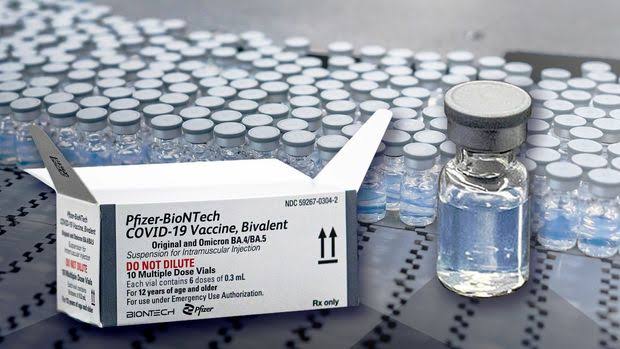
Anticipating an uptick in COVID-19 cases, the U.S. Food and Drug Administration (FDA) amended the emergency use authorizations of the Pfizer-BioNTech and Moderna COVID-19 Vaccines to allow the use of newly reformulated vaccines as single-use booster shots.

The updated COVID-19 booster is a bivalent vaccine developed to specifically target both the original COVID-19 strain and the recently circulating Omicron subvariants BA.4 and BA.5.

On September 2, the Philippines logged 656 new cases of the Omicron subvariants. Of this number, 624 were cases of the Omicron BA.5 subvariant, 13 cases of BA.4, 1 case of BA.2.12.1, and 18 cases tagged as “other sublineages.”

Booster shots are an essential line of defense against the COVID-19 virus as vaccines become less effective when it mutates.

“They can help restore protection that has waned since previous vaccination and were designed to provide broader protection against newer variants,” said Center for Disease Control and Prevention (CDC) Director Rochelle P. Walensky in a statement after briefing the public of the boosters’ use.

Data from clinical (human) studies with similar BA.1 bivalent boosters and nonclinical trials with BA.4/BA.5 bivalent vaccines have shown increased immune response against Omicron subvariants, while also demonstrating a “non-inferior” antibody response against the ancestral strain. The shots prompted reactions similar to the primary doses and have remained safe.

Pfizer Incorporated’s Vice President, Kena Swanson, suggested during a vaccine advisory committee meeting that preclinical data have “reliably predicted” the clinical results of variant-modified vaccines.

The U.S. FDA authorized the use of Pfizer-BioNTech bivalent boosters for anyone age 12 and older, while Moderna’s bivalent vaccines for adults 18 and older. Both shots require the completion of the primary doses and a 2-month interval following a primary or booster vaccination. The same eligibility criteria were recommended by the CDC.

The Marcos administration promised to look into the updated bivalent boosters and provide the shots to those who need them.

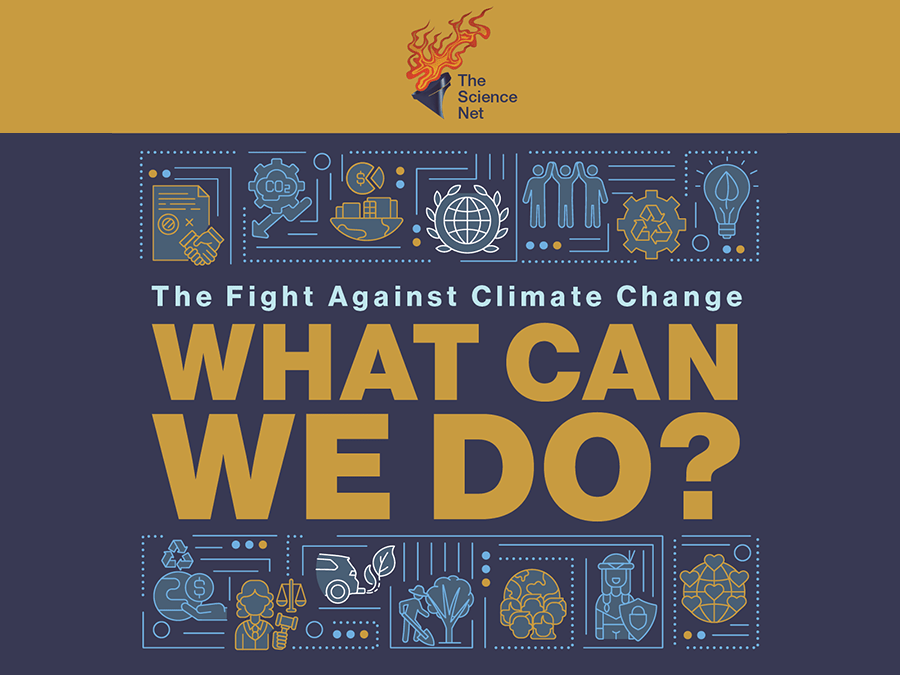
The Fight Against Climate Change

by: Gabriel Segura || Photo Credit: Louise Mikayla Lelina

On April 6, 2022, Peter Kalmus, a climate scientist working at NASA, chained himself, along with four others, to the entrance of Chase Bank. In a voice both defiant and fraught with trepidation, he decried the corporations and governments who have ignored the 50 years’ worth of research pointing toward a simple, irrefutable fact: human activity has accelerated the process of environmental change that will inevitably render the planet inhospitable to the human race. Disappointingly, he was met by 100 LAPD officers in riot gear and arrested, an approach inherent to those in power unwilling to heed the warnings of experts and concerned citizens because it means shaving a few percentage points off the profit margins. 

Spurred by the latest report of the Intergovernmental Panel on Climate Change, Kalmus, alongside a collective of over 1,000 scientists named the Scientist Rebellion, took to the streets bearing banners designed to shock passers-by to their core (“1.5oC is death!”, “Climate Revolution Now!”), which warned that “rapid and deep cuts” to greenhouse gas emissions are necessary by 2025 in order not to exceed 1.5oC of global warming. Indeed, in light of this impending deadline, one finds it difficult and pointless to operate as normal. However, in the face of potential auto-genocide by inaction, Kalmus says, “Never give up!”. Living amid a climate crisis may make nihilists of us all, he says, but while there is still time, one must take a rebellious stance and advocate for environmental reform. 

This begs the question: “What can we do?” The vast majority of the population seems to think that climate reform is a matter of personal responsibility, no doubt inculcated through the educational curriculum. Look through any elementary science textbook, and you will find that measures combating climate change amount to cursory soundbites such as “Don’t leave the faucet running while brushing your teeth,” “Turn off the lights when not in use”, et cetera. While these measures must, of course, be done, one must never fail to look at the bigger picture: the vast majority of greenhouse gas emissions are produced by the industrial processes of corporations and the energy generation of post-industrial nations. The bulk of the burden lies not upon the ordinary citizen but upon these bad actors, like JP Morgan, of which Chase Bank is a subsidiary, and the UN, both of which have recently unveiled to the public their “greener initiatives”, whereupon close inspection turn out to be all bark and no bite.

Therefore, the apt course of action would be to indict those holding the reins. The only language that corporations understand is statistics, so when their profits are slashed and in the red, only then will they listen to the consumers. Boycott and divest your spending money from industries that practice unsustainable production methods. Likewise, the populace must elect leaders committed to the fight against climate change and support policies that will cut down on greenhouse gas emissions, especially in the energy generation sector. We as Filipinos should be vocal, as due to our geographic position in the Pacific, we bear the brunt of most of the effects of climate change, having suffered through 8 typhoons, one of which was a super typhoon, and incurring above 60 billion pesos in damages. We must demand climate justice from developed nations and push them toward true sustainability. This problem goes beyond sectors and classes; we must unite against this rising threat.

PSHS-EVC holds its annual SMT Fair

by Vean Cordero || Photo Credit: SMT Fair Website

The Philippine Science High School – Eastern Visayas Campus (PSHS-EVC) held its highly anticipated Science, Mathematics, and Technology (SMT) Fair with the theme “PSHS-EVC at 30: S&T Solutions towards a Sustainable Philippine Development” via Zoom last March 28 and 29, 2022. 

This year’s SMT Fair was organized by the SMT Unit, led by Mrs. Leslie Cruto. They developed a website that served as the central platform for the two-day event. The fair commenced with an opening message from Campus Director, Ms. Yvonne M. Esperas. Keynote Speaker Mr. Michael Tonido also delivered a heartfelt message regarding his STEM career journey, inspiring students to continue pushing forward even when faced with adversity.

The interactive games for Grades 7 to 9 students, facilitated by Grade 10 students, were the highlights of the first day. The winners won SMT merchandise such as string bags, bucket hats, and tote bags. 

“This year’s fair, being my batch’s first, was certainly a memory I’ll hold dear for the rest of my high school experience,” said Grade 7 student Samuelle Ysidore. “The games weren’t completely related to school, so it felt refreshing. My batchmates and I can’t wait to play the games prepared face to face and celebrate the fair together in person soon!” 

The fair also had a research exhibit open for viewing to all students. The exhibit showcased the posters of two groups from the 12th grade containing the significant parts of their research study. 

On the other hand, the highlight of the fair’s second day was the Research Congress of the Grades 11 and 12 students. The Grade 11 students had their research proposal defense in the morning, while the Grade 12 students had their research paper defense in the afternoon. The evaluators included PSHS-EVC teachers and guests from external institutions, who provided insights and suggestions for improving the students’ research proposals and papers. 

“It was indeed helpful,” claimed Grade 11 student Daniel Aguilos. “We got experienced advice from our teachers on how to best improve our study by suggesting to try out more efficient methods and ways to conduct it.” 

As an audience member, Grade 10 student Kyle Abello said that the research congress was bittersweet. “Bitter because we know we’ll be the next ones to experience that and sweet since it inspired me and gave a ton of new knowledge which we could use for our research.”

Simultaneously, students from Grades 7 to 9 had the Maker’s Fest in the morning and the Career Talk in the afternoon. The 1st and 2nd placers in the Mascot Design Challenge of the Maker’s Fest, Grade 9 students Zenas Agnilla and Faye Rhianna AvendaĂąo, won cash prizes of Php 2,000 and Php 1,000, respectively. 

Students then attended career talks of three accomplished guest speakers: Abe Ernest Johann E. Isagan, Eddie Francis Cesar Plaza, and Edwin Miguel S. Anadon. They shared their experiences in their respective fields, boosting the curiosity and willingness of the students to pursue and explore more STEM careers.

To conclude the event, Curriculum and Instruction Division Chief Anariza Gozon shared in her closing message the purpose of this year’s SMT Fair: “to showcase our dearest student body’s resiliency, innovation, and creativity amidst the global crisis.”

Grade 12 Students Win Award in International Science Fair

by: Gabriel Segura || Photo Credit: Center for Research in Science and Technology Facebook Page

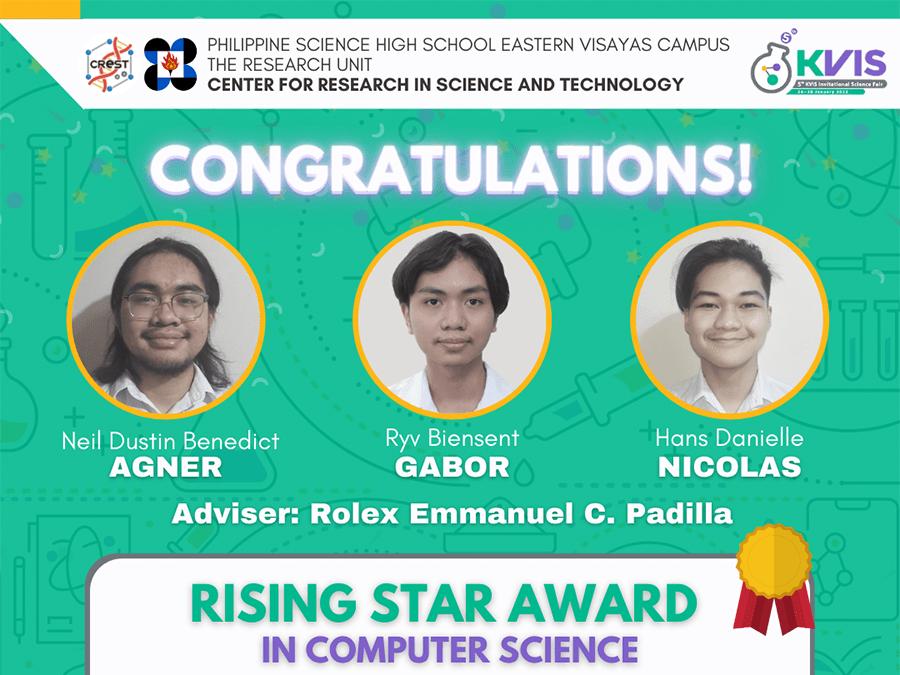
Three Grade 12 students from PSHS-EVC were awarded the Rising Star Award in Computer Science at the 5th KVIS Invitational Science Fair, held on January 24-28, 2022. The study, titled Electronic Registration, Logbook, and Scheduling System (ERLSS): Localizing Technology for Improving a School Registrar Office’s Functions, was presented by Neil Dustin Agner, Ryv Biensent Gabor, and Hans Danielle Nicolas. STR Teacher Rolex Padilla served as the team’s adviser, with assistance from other members of the EVC faculty.  

The KVIS International Science Fair, held by the Kamnoetvidya Science Academy in Thailand in conjunction with VISTEC in the spirit of global partnership and recognition. While the fair would normally occur on-campus, it was held remotely due to the ongoing COVID-19 pandemic, with this year’s theme being “Advancing Global Sustainability.” Participants hailing from over 15 countries gathered to present their studies within various scientific fields, with 4 awards in contention.

According to the presenters, the study was driven by a need to adapt remote processes conducted by the PSHS-EVC’s Office of the Registrar, who have continued to operate despite the online setup. Using XAMPP (a cross-platform web server stack) and PHP (a language used for web development), they developed a bespoke database with separate interfaces for both students and the registrar. Students would request through a web application, and once the registrar receives the requests, it would take them only a few clicks to supply the required documents. Accessibility and security, as well as streamlining data sorting and retrieval, were prioritized as chief design values. 

“We were inspired by the professionalism and aptitude of the other presenters,” said Agner. He added that “EVC’s history of participation in this and other science fairs proves that our research is on par with other countries – globally competitive, as it were.” Agner hoped that the award would, in turn, inspire other student researchers. The presenters thanked the CReST and EVC faculty, saying, “This study would not have flourished without their dedicated support.”