Breaking the Bonds

By: Allyssa Janice Capoquian || Illustration by: Kyla Campo

A notable shift in the Philippine legislative landscape occurred on September 19, 2023, when the Senate of the Philippines approved a bill providing a legal ground for absolute divorce. The approval of the bill did not mean it had already been passed into a law. However, its passing could usher in a major reformation to the conservative Filipino society. Sen. Risa Hontiveros, the one who passed the bill, stated that, “The passage of a divorce law is one of the ultimate forms of freedom we can give Filipino women.” In a nation of conservative and patriarchal tendencies, the bill aims to provide every person, especially women, with an equal footing- an ability to make a choice. 

The Philippines has long been known for its strict laws against divorce. The country emphasizes the sanctity of marriage, but fails to see the prevailing issues found in that union. Domestic violence remains a pervasive issue in our country. According to the Philippine Commission on Women, one in four Filipino women age 15-49 has experienced physical, emotional, or sexual violence by their husband or partner. However, many women subjected to abuse do not report their experiences. The culture of victim-blaming has led to silence amongst abuse victims. This can be connected back to the strong societal and religious norms in the country, and their desperate need to uphold the patriarchal family image. 

Moreover, the country is unsuccessful in providing a strong justice system for these victims. They end up staying in these toxic marriages because they are not provided the support or opportunity to escape from those harmful situations. Even though annulment is a possibility, it is far too long a process and far too expensive for the working-class to afford. The tedious and unaffordable process of annulment ironically exhibits the Philippines’ perpetuating stand against divorce.

Additionally, women stay in abusive marriages for their children. But abusive or unhappy marriages also affect the development of children who are exposed to those stressful conditions. Children constantly being exposed to an aggressive environment are more likely to develop aggressive tendencies, or perceive that aggression as normal. It may dissuade them from marriage altogether. According to The Child and Youth Welfare Code, children are entitled to rights providing them with familial security and protection from harm. These rights can be neglected in abusive or dysfunctional households. Divorce, in many of these situations, could have been a gateway to stop these problems before they could worsen. 

It is expected that coming from a predominantly Catholic country, many Filipinos oppose the bill. However, it is essential to emphasize that the passing of this bill was not made to undermine Catholic beliefs, but simply meant to provide the option for people to divorce and remarry. In our democratic country, everyone should be given a choice. Everyone should have their rights upheld. The Senate’s approval of the divorce bill is not meant to disrespect anyone’s religious beliefs. Rather, it is another path bringing progression, freedom, and inclusivity into this nation.

When Home is too Far From Reach

by: Lianna Lopez || Illustration Credit: Ashkinaz Canonoy

Stack-by-stack, elementary school textbooks piled themselves on top of one another on the round table of the family dining room. Along with them was a collection of old and crumpled academic worksheets and eraser debris scattered all over. In the midst of it was a girl in thick-rimmed glasses absorbed in the confines of academic work. But this isn’t about her. It’s about the boy who slept just a room away from where she sat. It’s about his story and a visitor whose presence did wonders. A visitor whom we’ve all met at least once in our lives. 

Unlike that overachieving little girl drowned in the sea of academic life, this lad was stuck still and lost sitting on a boat in the midst of turbulent blue ocean waves. His tiny boat fits just him— no room for stacks of textbooks, used worksheets, thoughts of anything of the sort. It was a place devoid of any living human but himself. A place where he was alone, and his notions could go uncharted–where home was nowhere near. He was lost. Afraid? Maybe. However, on that Sunday noon, he was in a deep lonely slumber.

“Maupay nga udto,” the woman with a neat high bun greeted as she entered the house. The kid sat by the table looked at her curiously, slightly intimidated by the presence of a stranger in her home. She observed the visitor as she stood there with a warm smile on her face, one so warm and bright the gloomy weather did not feel as gloomy as it should have been. Shortly after, she fell into a conversation with the mother whose hands were damp and clammy as she led the woman who had introduced herself as the boy’s teacher and homeroom adviser to the room wherein the boy had himself barred in. She let herself inside.

She let herself sail across the dark, barren, and solitary waters the boy had remained afloat in for the past several days. He had spent the minutes and hours of the clock and the days of the calendar locked in this cataclysmic abyss, losing touch with the other world–refusing the hand of those who had tried reaching in. Yet, this woman, whose black and white-streaked hair, perseveringly and unrelentingly took in the extra time, work, and effort willingly on a Sunday noon to reach in for this helpless student. She could’ve used the day to spend time with her own family, but she was here. This spoke volumes.

He was a failing student. Left too much astray in the dark. Yet, this teacher had lost no hope in him. She had welcomed him, and had urged him back. And that says even more. 

She was his teacher: a second parent, a second mother. She was someone who had cared and understood enough to unwaveringly reach out to a student whose times had been difficult. Someone who would not so easily let her own student stray away and give up on quality education, on a future that awaits him. She is who a teacher is. She is who teachers are. 

They are not just educators in the classroom but also guardians willing to guide their students outside of it —whether these be about complex trigonometry and stoichiometry problems, or the heart-wrenching argument from last night’s dinner. They are the adults these children can turn to for advice, knowledge, and values essential to their growth as human beings. They are the grownups outside of their homes who can help mold a brighter future for these young individuals. 

As students, we have encountered these teachers. They, who’ve helped us as we’ve, at least once, strayed far too deep beyond the dark waters of this world. When we’ve found ourselves furthest in thunderous storms and desolate seas, they are the lighthouses that guide us in whipping through the challenges and sailing our way back to the right path in dreary times. 

When home is too far from reach, we see our beacons of light: we see our teachers— our life counselors, our academic instructors, our second parents, and everything more. 


Editor’s Note:

We at the Science Net are more than grateful for our teachers who make EVC home. To our second parents, greatest confidants, and unsung heroes, your dedication and love are truly worthy of all recognition.

Thank you for imparting to us your superpowers, so that one day, we, too, could become the heroes in our own stories.

Happy Teacher’s Day!

Smog or Vog? Deteriorating Air Quality in Metro Manila

by: Qwynz Bonachita || Photo Credit: Mark Balmores

On September 22, 2023, a dense gray fog settled on parts of Metro Manila, alarming both residents and experts. Initially thought to be Taal Volcano’s volcanic smog (vog), the Department of Environment and Natural Resources Environmental Management Bureau (DENR-EMB) revealed that rather than volcanic emissions, the atmospheric phenomenon was intricately linked to the emissions from heavy vehicular traffic.

The Philippine Institute of Volcanology and Seismology reported that the vog from Taal Volcano is drifting west-southwest, steering clear of the Metro Manila area—a finding in concordance with DENR-EMB data.

Vehicles and stationary sources are the main emitters of particulate matter. Particulate matter or particle pollution are tiny pieces of solid or liquid particles that are in the air. These particles may include dust, dirt, soot, smoke, and drops of liquid.

For years, the DENR has emphasized that automobiles contribute 80% to the pollution levels in Metro Manila, with the remaining 20% being attributed to emissions from industries, construction sites, and even open-air burning.

Some parts of Metro Manila are experiencing hazardous air quality levels. Parañaque City records an Air Quality Index (AQI) of 217, Pateros at 141, and Makati City at 128, all of which have exceeded the guideline value of 35 micrograms per normal cubic meter (µg/Ncm), classifying these areas as “acutely unhealthy” for residents.

In a press briefing, Secretary Renato Solidum clarified that vog was only present in the Batangas atmosphere, whereas the one in Metro Manila was a smog induced by thermal inversion, where the air temperature is lower at the surface than it is above.

“It’s not vog; it’s smog. Not related, but the smog in Metro Manila can affect health. When outdoors, wear masks. When indoors, seal off doors and windows,” Solidum advised.

The Department of Health has echoed this sentiment, urging the public to remain indoors and limit outdoor activities to mitigate exposure to both vog in southern Luzon and the smog blanketing Metro Manila. Furthermore, keeping doors and windows shut and wearing masks when going outside are recommended, with ample hydration to counteract any potential irritation and dryness.

Augmented Reality: Enhancing Our World One Overlay at a Time

by: Kyle Abello || Photo Credit: U.S. Chamber of Commerce

You turn on TikTok to a prank video of a person being startled by a spider crawling on their face, then probably scroll more to a person using a filter that morphs their face to adjust the gap between their eyes. Say you wanted to take a new display picture for your social media pages, so you go to Snapchat and try on some of their filters to add some flavor to your picture.

These examples of popular social media gimmicks are an application of Augmented Reality (AR). As outlined by Microsoft, AR is an enhanced, interactive version of a real-world environment achieved through digital visual elements, sounds, and other sensory stimuli via holographic technology. AR incorporates three features: a combination of digital and physical worlds, interactions made in real time, and accurate 3D identification of virtual and real objects.

AR offers a better way to design, curate, and deliver consumable instructions by overlaying digital content in real-world work environments. AR, like many other technologies nowadays, was not made overnight. The first AR technology was developed in 1968 at Harvard when computer scientist Ivan Sutherland, tagged as the “father of computer graphics,” created an AR head-mounted display system. Over the following years after its first development, companies, universities, and government agencies have advanced AR for wearables and digital displays, which superimposed virtual information on the physical environment, and allowed simulations that were used for aviation, military and industrial purposes. However, it wasn’t until 2008 that the first commercial AR application had been developed.


Both hardware and software components contribute to making AR function: hardware components like sensors, cameras, and processors; and, software components, like image recognition, Artificial Intelligence, and AR software for processing. 

AR has two types, each of which have a unique way of displaying your images and information. The first type is marker-based AR. Image recognition is used to detect objects that have previously been programmed into your AR device or application to generate marker-based AR. These markers can assist your AR device in determining the position and orientation of the camera by being placed in the field of vision as points of reference. In most cases, this is accomplished by converting your camera to grayscale, detecting a marker, and then comparing that marker to every other marker stored in its information bank. Once a match is made, your device uses that information to calculate the pose and position the AR image appropriately. 

The second type of AR is marker-less. Marker-less AR is more complex because there is no fixed place for your device to focus on. Your device must therefore be able to distinguish objects as they come into view. The device will first identify the object using a recognition algorithm that looks for colors, patterns, and similar features. Then, using time, accelerometer, GPS, and compass data, it will either orient itself or use a camera to overlay an image of whatever you want over your actual surroundings.

Interestingly, there are many applications of AR in the real world: education for immersive learning experiences and remote collaboration; healthcare for medical simulations and patient care and rehabilitation; architecture design for real-time project visualization and virtual walkthroughs; retail and marketing for virtual testing of products and personalized advertisements and promotions. 

Despite the given advantages of AR, it still has some challenges and limitations. Technical challenges of AR include latency and performance issues, image recognition and tracking limitations. Additionally, AR also has ethical concerns related to data security, user privacy, and psychological and societal impacts. Accessibility is also a concern with AR due to the high cost of AR devices and applications along with the growing digital divide.

AR will surely develop in the coming years, with advancements in devices like wearables and AI and machine learning integration. In addition, AR could also potentially be used for smart cities and infrastructure, scientific research, and even for seamless integration into everyday life.

Proving its fascinating yet useful use, AR has been improving from its creation to more widespread application. Like many other technologies, it has its own share of concerns that need to be addressed, but overall, the possibilities of AR are endless. So, the next time you use social media filters to enhance or morph your appearance, think about AR and its potential to make an impact to society beyond the light-hearted social media gimmicks.

Environmentally Backward: The Rise at Monterrazas

by: Nathaniel Dela Torre || Photo Credit: Monterrazas Prime Cebu Facebook Page

An architecturally forward design is how vlogger and engineer Slater Young describes his latest project, “The Rise at Monterrazas.” According to Young’s video, the project is designed with three pillars in mind: uniqueness, usability, and sustainability. However, as architecturally forward as it may seem, its detriment to the environment is a looming cause for concern.

The Rise at Monterrazas is a luxury condominium slated to be built at Monterrazas de Cebu. With its design integrated with the mountain, one might wonder, ‘How much of the environment will be destroyed for this project?’ Imagine the hectares of land that will be eroded and the amount of trees that will be cut down for its completion. These threats are only some of the concerns that netizens and environmentalists alike have raised regarding the project.

An architecturally forward design does not have to be environmentally backward. In his video, Young stated that they spread the whole structure out across the mountain to lessen its environmental impacts, however, was there a need to impact the environment in the first place? Another high-rise condominium could have been built elsewhere, preserving a natural safeguard against disasters for residents in the area. 

The Monterrazas de Cebu near the project itself received two cease and desist orders in 2008 and 2011 from the city’s local government units due to its effects on the residential areas. On both occasions, the development was ordered to stop because of the large-scale flooding it caused in the nearby sitios and barangays. These floods were observed and believed to come about as a result of the project’s development. Who’s to say that this will not happen again once the Rise at Monterrazas condominium reaches its development stage? This project is creating more housing for the rich at the expense of the common people’s safety.

The sustainable solutions that the project team presented are merely facades constructed to hide their employers’ greed. Creating a view that resembles the renowned rice terraces would set their condominium apart from the rest of the luxury housing in the country, no matter the cost. The sustainable solutions presented are only band-aid solutions to the detrimental effects this project would have, not only on the environment but also on the residents living nearby.

We should not forget that the environment is the foundation of our existence. From the resources it provides to the protection it offers, we, as inhabitants of Earth, should always prioritize its preservation. However, considering the rapid pace at which we are destroying its beauty and gifts, we must always remember that the environment has its own ways of retaliating, it always knows how to strike back.

Pisay-EVC studes share insights during Safe Spaces Act forum

by: Kyle Andrew Abello || Photo Credit: Kiara Gaut

Aine Latoja and Chamuel Petilla, students of the Philippine Science High School – Eastern Visayas Campus (PSHS-EVC) graduating class of 2024, both gave their insights on the Safe Space for All forum organized by the Student Services Division (SSD) on September 22 in the school auditorium.

During the forum, Latoja said that sexual harassment is a serious issue that needs to be addressed, especially since, as a woman, she has experienced first hand being catcalled in supposedly safe spaces.

“It’s good to be informed that there are legislations imposed that do not tolerate this kind of behavior,” she said, while also outlining the importance of policy makers’ role to use their power to address these issues.

“The safe spaces act is the first step to combating these problems; whether online, in public places, or in school, everyone has the right to safety and protection,” she added.

Petilla also articulated his thoughts on the Safe Spaces Act, mentioning that it was a watershed moment in the long fight against discrimination and a victory driven by people who refused to be silenced by the forces of unjust and prejudicial treatment.

“The [Safe Spaces Act] pushes safety and respect in our communities, and with it, we must take all precautions to make sure we can make a space as safe as possible,” he said.

Urging communities to fight gender inequality together, Petilla further stated, “In schools in particular, we need to do better in ensuring that all students feel safe and assure that they can freely report these incidents when faced with these predators and harassers.”

“Remember, their fight is our fight, and your fight is our fight,” he ended his speech with a reminder for students to speak up when faced with gender-based discrimination, proclaiming that the Safe Spaces Act is there to support their pursuit of justice.

Headed by Assistant City Prosecutor Atty. Marianne Hazel M. Badillo, the forum—aiming to educate school communities to cultivate proactive measures against gender-based sexual harassment—focused on the contents of the Republic Act 11313 Safe Spaces Act or Bawal Bastos Law.

PSHS-EVC Wellness Core Group attends life coaching seminar

by: Josh Aseo || Photo Credit: Jessa Turalba

To strengthen the support system for students’ well-being, the Student Services Division (SSD) and the Guidance Office of Philippine Science High School-Eastern Visayas Campus (PSHS-EVC), organized a Wellness Core Group training to 29 personnel at the C Pavillion Lounge at San Jose, Tacloban City, September 18 & 19. 

Ms. Kay Zabala, founder of the KKYZ Life Coaching Services, gave a lecture on how to connect better with students with regard to their mental well-being. Included in the lecture were issues on the mental health stigma, debunking myths about mental health, and how education should properly come into picture.

According to Ms. Alona P. Peleño, the school’s guidance counselor, the purpose of the core group is to live up to their mantra: “presence, support, and connection.” She also mentioned that the presence of the wellness group and the support that they can offer, can form a stronger connection between the faculty and students. 

“It’s so cliche but I think it still runs through that it’s okay to not be okay. Since there’s help available, you don’t have to just isolate yourself. These people are willing to help, the Wellness Core Group coaches are there for you,” she added. 

She also said that students often feel scared when they are associated with the Guidance Office. However, the Wellness Core Group aims to disarm that stigma, as they work on their advocacy to improve the well-being of the EVC community.

Gilas on fire in World Cup bid, eyes Olympic spot

by: Fionna Canales || Photo Credit: FIBA

Reaching new heights in the sports scene, the Philippines hosted the highly anticipated Fédération Internationale de Basketball (FIBA) World Cup 2023, kicking off the tournament with a chart-buster crowd enthusiasts of 38,115 on August 25 at the Philippine Arena.

The country, together with co-hosts Japan and Indonesia, organized the event with a total of 32 teams participating in 92 matches over the course of the competition, all in an effort to take home the famed Naismith trophy.

As national representatives, this year’s roster of Gilas Pilipinas was composed of Jordan Clarkson (bearer of NBA’s sixth Man of the Year in 2021), Ariel John Edu, CJ Perez, Dwight Ramos, Jamie James Malonzo, Japeth Aguilar, June Mar Fajardo, Kiefer Ravena, Kai Sotto, Scottie Thompson, Rhenz Abando and Roger Pogoy. Head coach Vincent “Chot” Reyes and assistant coach Earl Timothy Cone led the Gilas team.

Despite the valiant battle, Gilas tumbled to a heartbreaking defeat over the Dominican Republic, 87-81, when their phenomenal point guard Clarkson fouled out of the game down to the last minutes allowing the Dominicans—led by NBA star Karl-Anthony Towns—to ravage through the home team and take their first victory.

On the brink of an early exit, the Philippines failed to clinch its arguably biggest chance to win in Group A after an 80-70 upset by Angola before a dazed home crowd.

Following their lose streak, Gilas finally kissed their second-round bid goodbye in the competition after bowing to Italy with a 90-83 mark on the scoreboard.

Down to the classification round, the team suffered its fourth consecutive loss to South Sudan, 87-68, to the dismay of the nation as this loss resulted in Gilas being ruled out of securing a spot at the 2024 Paris Olympics.

“I’ve had numerous times to say that I’m really sorry that we were not able to deliver, and I take full accountability. I take full responsibility,” head coach Reyes said in a postgame press conference over the team’s losing streak.

“We just like to say that, as difficult and as disappointing the campaign has been so far, I’m still very proud of the effort. [The] guys put themselves on the line. [We] fought our best,” added Reyes.

Down to their last game, Gilas Pilipinas’ near decade-long wait for its first FIBA World Cup win was over as Clarkson saved the best for last, impressing across the board with 34 points to secure a 96-75 win over China.

With the win, the Philippines officially qualified for the Olympic Qualifying Tournament (OQT), securing one of the 19 spots in the World Cup.

The FIBA World Cup 2023 ended with a historic championship triumph by Germany, defeating Serbia to take home their first-ever World Cup title. Dennis Schroder, who led the pack for the team’s Cinderella run, was named as the tournament’s Most Valuable Player.

With the culmination of their World Cup campaign, Gilas will next take part in the pandemic-delayed 2022 Asian Games in Hangzhou, China with a new Final 12 and interim coach Tim Cone. 

Hontiveros, Diokno grace PSHS-EVC’s SAGE ’23 Miting de Avance

by: Gabriel Vinci Tamayo || Photo Credit: Rizh Mañago

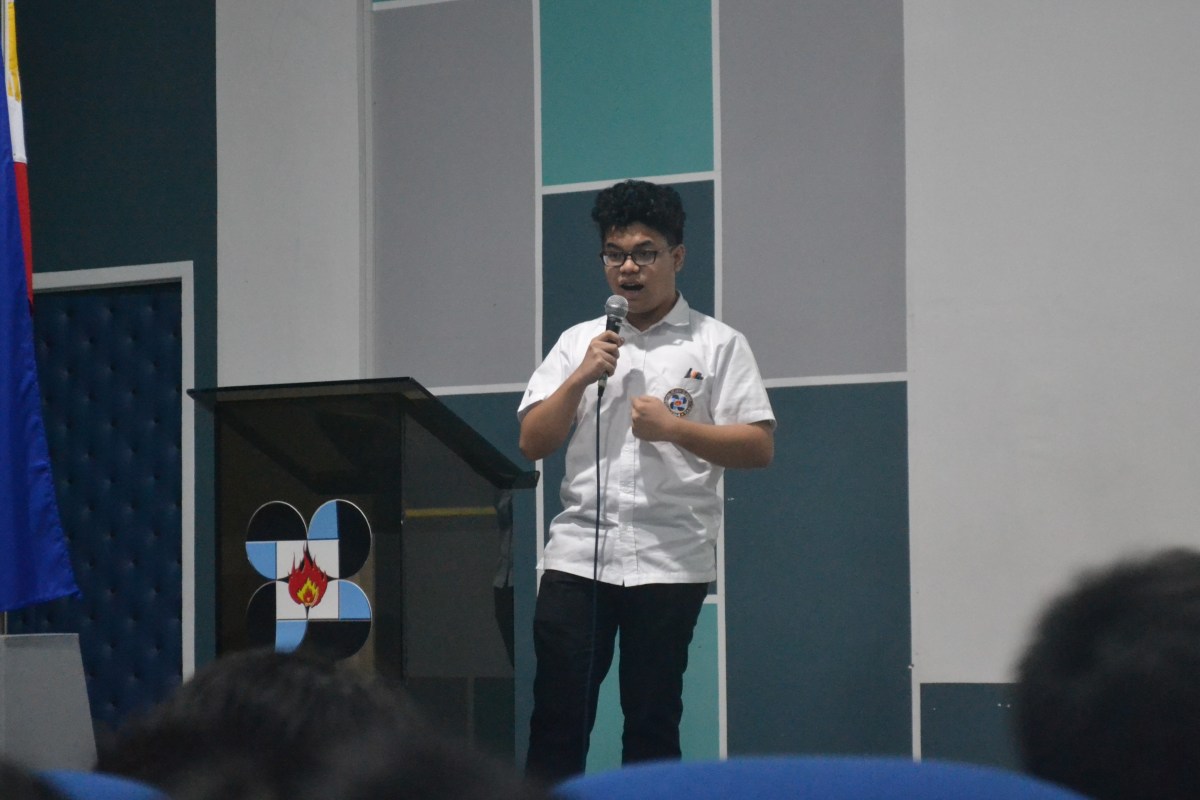
Senator Risa Hontiveros and Atty. Chel Diokno virtually graced the Philippine Science High School-Eastern Visayas Campus’ (PSHS-EVC) Student Alliance General Elections (SAGE) Miting de Avance, September 8 at the school gymnasium. 

Hontiveros inspired the Pisay scholars through a video message, wherein she emphasized that standing up alone in a room full of people sitting down is an act worth commending.

“If you are guided by constant reflection and discernment, by deep empathy for the most marginalized in our society, if you know you are on the right side of history, you can never be alone,” she said.

On the other hand, Diokno, Dean of the De La Salle University College of Law, stressed the importance of picking the right school leaders.

Napakahalaga ng proseso na ating isinasagawa kasi ito ay bahagi ng demokrasya [The process we are executing is very important as it is a part of democracy],” Diokno said.

Magagamit natin ang kaalaman na ito bilang gabay sa pagpili ng mga susunod na leader sa ating paaralan [We will be able to use the knowledge that we will gain today as basis for choosing the next leaders of the school],” he added.

SA Adviser Vesifina Ron also highlighted the significance of making our collective voice heard and choosing leaders who will guide us toward excellence.

“The leaders that will be selected today will have the opportunity to drive positive change onto school initiatives and inspire kids to meet their fullest potential,” she said.

Candidates for the SA Elections this year included eight students from the Purveyors of Unity in Leading for Service and Opportunities (PULSO) Party and two independent candidates running for the positions of Public Information Officer and Vice President.

Voting for the next SA Officers took place on September 11, 2023 in the Computer Science Laboratories of the campus.

PSHSS kicks off PisayCom ’23

by: Samantha Macabit || Photo Credit: Jerry Serdeña

With the theme “Creating compelling promotions to spread science news on social media”, the PSHS System conducted PisayCom 2023, a system-wide event attended by selected scholars, held online last August 29-31.

The event formally kicked off with a welcome message from Dr. Renato U. Solidum, Jr., Department of Science and Technology (DOST) secretary, followed by an opening address by Ms. Lilia T. Habacon, executive director of the PSHS System.

In a keynote address, Mr. Howie Severino, former GMA Network’s Vice President for Multimedia Journalism, emphasized the amount of power the current generation holds when it comes to sharing information through social media.

“Today’s generation is empowered to share, create, collaborate, and mobilize like never before,” he said.

Aside from that, Mr. Alvin Hizon, multimedia specialist, discussed the importance of science communication through social media in terms of its content, graphics, and layout. Meanwhile, Mr. Jose del Rosario, multimedia artist, tackled how to create posts that capture the viewer’s attention.

On the second day, Mr. Ron Lopez, former correspondent of ABS-CBN News, gave a keynote speech on accurate e-news reporting. Furthermore, Mr. Adrian Paul Conoza, special features and content editor of BusinessWorld Publishing Corporation, talked about writing for e-publication and Mr. Louie Gerodiaz, frontend web developer, gave a live demonstration on how to consider the different elements in a website layout.

On the third day, Mr. Resty P. Balila, program manager of DOSTv, delivered a keynote address about making science interesting through audiovisuals. On the other hand, Dr. Ruby Cristobal, news anchor of DZRH’s Radio Henyo, handed out tips when it comes to educational vlogging and gave an activity to the attending scholars.