If Love..

By Ces Suarez, Roj Faelnar, Joshua Mendoza, Samuelle Jagonio, Clara Canta, Allysa Capoquian || Graphics by Rei Alinsub

If love were only romantic, many of us would be unloved. When we measure love only by whether we have someone to call ours on February 14, we overlook the many ways we are already held.

The absence of that kind of love can feel—almost accusatory—as if the day itself requires a partner. But love has never been narrow. It lives in places far less dramatic and far more enduring: in the friends who stay, in the hands that raised us, and in the small, daily acts that ask for no spotlight. 

The Love That Sees Beyond The Face 

Friendship, for as long as I have known its name, had people enter and leave my life as if they never cared to stay. With that, I learned to protect myself by keeping certain parts of me hidden, fearing they were too fragile for anyone else to hold. And so, I categorized the people I met into three sections: those who knew my face, those who knew my marrow, and those who knew my truths rotting beneath my ribs. It was a flawed system, but a system nevertheless—one I hope that would guide me and show me the people worthy of sharing my rib with.

Friendship, I have learned, isn’t just easy laughter or hands held only in daylight. It is the quiet ease of resting your heads against one another in total understanding. It is the bravery and the embrace to occupy spaces no one ever seems to settle in. While I have only known shards of my people for a short time, it feels as if I have carried them further and further. With them, I was taught to remain loud, and louder wherever I go, to implore grace within myself, and to live a life not of certainty, but of learning.

For this, I am eternally grateful. I am grateful to have found the people who became the answered prayers whispered in solitude. I am grateful for the way that they hold the weight of my truths without complaint and  for choosing to return to me every day. To them, I give nothing less than a piece of my rib.

The Love That Fit Inside a Paper Bag

I grew up in a small town called Sogod. It was never famous, but those who knew it spoke softly of its beaches and the unhurried rhythm of provincial life. Within that geography of sea breeze and tricycle engines, I loved one place specifically: Mayong’s Bakeshop & Snackhouse

Every day at two in the afternoon, a new batch of bread would emerge from the ovens. My family, as if summoned by something sacred, would begin our small pilgrimage for monay, cheese rolls, and shakoy. It was such a simple habit—almost trivial—yet in its repetition lived something steady and profound: care expressed in coconut-filled bread. It was never just bread. It was two o’clock. It was family. It was knowing exactly where I belonged.

Time, of course, has a way of stretching us away from such rituals. I have grown older; the glass display at Mayong’s has yellowed, and the once-familiar scent has grown faint in my memory. 

But sometimes, when I pass a bakery and catch that familiar fragrance of sugar and yeast drifting into the air, I feel something small and bright tug at my heart. I am back on those roads, the afternoon sun above us, the panadero placing three pan de cocos into a paper bag. I remember then that love does not always arrive in bouquets or love letters; sometimes it arrives warm, slightly sweet, and shared without fuss, and inside a paper bag. 

The First Form of Love We Meet

Before infatuation, before the trembling thrill of crushes, there was a love that paused its own exhaustion to sit beside me and explain equations I was too frustrated to solve. A love that folded away unfinished paperwork to help with mathematics and physics. A love that thinned its own savings just to place a Lego set into the eager hands of a child who believed the world could be assembled from colored bricks. 

This love preceded my first cry. It was there in the hush before my birth, in the anxious prayers spoken over a life not yet held. Parental love is not loud; it is foundational. It is the ground beneath the house—unseen, yet carrying everything.

Yet, I am not always gentle with it. 

During arguments, it is frighteningly easy to forget the devotion that has held me upright for years. Anger narrows my vision until I see only the present fracture, not the history of hands that steadied my first steps or applauded my earliest, clumsiest victories.

But never for long. 

I remember the sleepless nights they surrendered without complaint, the silent recalculations of their dreams so mine could expand. My first word was spoken into their waiting silence; my first step was taken toward their open arms.

So when I think of Valentine’s Day, I do not first think of crushes or flowers. I think of the love that loved me first. 

The Love Of A Writer’s Bump

I first noticed the bump on my right ring finger when I was seven, half-asleep in English class. After what felt like the hundredth loop of a lowercase g, the skin on my finger had risen red and tender, as if protesting the pressure of my pencil.  To little me, it looked like an abnormality—something gone wrong. To me now, a decade and countless journal entries later, it feels like more of a testament of years of desperate attempts of preserving memory into paper.

I have always written with more force than necessary, as though pressing harder might make the moment stay. At the end of every day, I make it a habit to crack open a lamp and my journal and write about the golden light I’d caught weaving through the leaves of my favorite trees during the walk I’d had with my friends. On some days, I’d write letters I’d never send and keep rewriting them until the paper softened at the creases, my affection spilling helplessly at the mercy of my pen.  Relentlessly pressing down out of desperation to put a name on the warmth that floods my heart and engrave it onto something that would make it last forever. This act of love is what gives me life and there’s nothing more that makes life worth living than the people in mine. 

Over the years, the bump only grew—rougher, more defined—formed by an urgency I could never quite explain. A quiet desperation to remember as many days of my life as possible before they slipped away. And so the skin thickened where the pen met my finger, as if my body itself refused to forget.

To buggy bumps and blooming flowers. To the small marks that proved we have lived, and loved, and tried to make it last.

The Love I Did Not Notice 

For a long time, I believed that friendship had to be loud to be real. I measured it by late-night conversations, constant updates, inside jokes posted for everyone to see. And when I looked at my own friendships—quiet, unassuming, rarely demanding—I wondered if there was something wrong with me and my friends. 

We did not narrate every detail of our lives to one another. We did not fill weekends with grand plans. Sometimes, I felt as though I barely knew them at all. I’ll admit that at one point, I found myself imagining how life would be if I sought friendship elsewhere, in people louder and bolder. 

But time has a gentle way of correcting what insecurity distorts. I realized that our relationship was exactly the space we needed to grow. The reason our friendship was quiet was not because it was shallow. Rather, it was because it had become such a sure thing that it no longer needed to shout for attention. It lived in the doodles in the margins of our notebooks, in the quiet assurance that no matter how long the pause, we would return to one another without hesitation.

Love As A Matter Of Possibility

Theory claims that the infinite universe has an inexhaustible amount of matter. Love, as intangible as it is, follows the same laws that govern matter. It cannot be created nor destroyed, only conserved and converted into newer forms. We are all born taking up space. In our initially small forms of mass is a body made up of matter and I believe to also be full of love. The best part about theory is that it leaves room for possibility. An infinite universe means an infinite amount of ways that love can prevail, with my favorite perspective being that love cannot be fostered without community.

There has always been a friend, a parent, or a mentor that has taught me a new way to love. Through trust, belief, and the knowledge that my existence holds weight, love has fueled my life with its endless generosity. Where uncertainty usually breeds fear, I am only comforted by the infinity of this feeling, the possibility of the companionship that will continuously welcome me in the future. So, as a being of matter, it’s only in my nature that I continue to love despite it all.

The Love We All Have

Love refuses to be bound by a single meaning. Because of this, love is less a definition and more a perception; it shifts depending on who is looking and what they have survived.

A child may know it as protection. A friend may recognize it as understanding. A parent may practice it as devotion without applause. To explore love, then, is not to confine it to one meaning, but to listen to the many ways people have learned to recognize it in their own lives.

Have Yourself A Merry Little Christmas

By Roj Faelnar || Graphics by Rei Alinsub

Christmas doesn’t arrive the way we pretend it does. It doesn’t fall from the sky fully formed, wrapped and glowing. Nor does it come on a creaking sleigh pulled by a red-nosed reindeer. What arrives first is the waiting—the long, restless kind. The kind that settles in your chest as soon as the first “ber” month hits, when lights begin to appear but the feeling hasn’t quite caught up yet.

As kids, we thought Christmas simply happened. That one morning, the world just woke up softer. Maybe that’s why we grow up to say, “Christmas feels different now”. Yet, the feeling we wait for does not merely come from the calendar. December alone does nothing. What actually happens is simpler, and far kinder. 

Christmas was never something we received. It was something being made around us, quietly and collectively, from the small efforts of ordinary people. 

It is built in parols swaying outside houses, uneven and handmade, but still glowing faithfully each night. It is in the sound of laughter echoing down the street as children rehearse carols, voices cracking, turotots slightly off-beat. This season is built on decisions that look insignificant until they accumulate; small efforts that don’t look like much on their own, but somehow gather into something warm.

Sometimes Christmas arrives quietly, not with fireworks, but with the sound of a gate creaking open past midnight. It is a father coming home tired, shirt wrinkled, worn shoes scraping the floor as he sets down a familiar white box on the table—Krispy Kreme, the kind with Snoopy printed on the lid. 

The feeling we associate with the season—the softness, the pause, the strange way time seems to slow—did not and still doesn’t come from the holiday itself. It comes from people agreeing, consciously or not, to act differently for a while. To speak more gently. To choose warmth over indifference. To give a little more patience than usual. To make a little more space, even when space is scarce. 

In a Filipino home, Christmas isn’t contained within walls; it spills out. Food stretches further than it should, overflowing onto extra plates, foil-covered trays balancing on laps. Chairs are pulled closer together until elbows brush and laughter spills over. Relatives arrive unannounced, bags of food in hand, while a tumble of slippers and shoes crowds the doorway. 

We wait for Christmas as a break, a pause from pressure, from expectations that do not rest. But slowly, we learn that the relief we feel is not handed to us. It is created. It is created by parents who flip through bills under the dim glow of a kitchen light, the faint hum of a fan being their only companion. It is made by classmates who excitedly play Manito Manita with oddly wrapped gifts. By families who insist on gathering, even when it would be easier not to. 

This is the unspoken truth: Christmas only feels real because people work to make it so.

And when it finally settles in, when the laughter sounds different, when the night feels fuller—it feels earned. Not waited for, but made. It is constructed from shared effort, shared fatigue, and shared gentle hope—just enough to warm the pause between one year and the next.

That is why Christmas lingers. Not because it is perfect, but because it is human. It meets us where we are—older, busier, a little worn—and offers something gentler than excitement. It offers meaning that does not rush.  

It asks us to contribute, not consume; to participate, not just expect. It asks us to understand that the feeling we long for is not something we stumble upon. It is something we owe one another.

Christmas was never meant to arrive on its own. It was always something we had to build—piece by piece, moment by moment. And in doing so—despite the year, despite ourselves—we make the season real.

When December finally passes, what lingers is not the noise, but the stillness it briefly allowed: a reminder that even in a loud world, there are moments meant to be held carefully.

Unhidden Horrors

By Samuelle Jagonio || Illustration by Mavi Hipe

There was a knock at the door.

I remember it clearly—the way it cut through the faint hum of Bandila news playing on our old TV. I was tucked in bed, pretending to be asleep while my daddy-lo watched the evening news. That was our quiet ritual before sleep: me, half-awake under the blanket; him, half-listening to the anchors’ tired voices, sighing every now and then like the world had just disappointed him again.

Then came the second knock—louder, faster, almost desperate.

Daddy-lo, half-asleep and still in his worn sando, shuffled towards the noise, grumbling to himself. When he pulled the door open, what greeted him was not a poor, innocent neighbor in need of help, but the cool midnight air and the smell of rain-soaked soil. No one was there. Only the hiss of wind through the trees and the faint licking of a burning flame in the distance.

Then came the yelling, the trembling of the ground as neighbors rushed down the muddy road clutching their children and trudging their belongings. “The hospital,” one cried, catching the bewildered look on my lolo’s face, “It’s burning!” The sky still rumbled from the storm that had passed hours before, and the air lingered with the smell of ash, salt, and something else—something foul that clung to the air.

By dawn, the ashes had settled. Some swore it was the work of a sigben, a creature said to linger by the dead and dying, and what better place to feed on the scent of suffering than in a hospital? Others whispered of curses, of the storm as a sign that something evil had been unleashed upon us all.

The truth, however, was more mundane, more monstrous in its simplicity: the hospital was built on lies and cheap cement—hollow blocks and hollow promises held up a structure meant to heal. Corners were cut, funds disappeared, and years later, people still chose to believe in creatures rather than corruption. The sigben and other mythical creatures became the scapegoat for every tragedy, while the true monster—one with a name, an office, and a practiced smile—walked free among us. After all, it’s easier to fear a myth than to confront a man in a suit.

Now, a decade of silence later, the true horror has stepped into the light. The culprit, a well-loved politician with a polished smile—now in even more polished handcuffs—was arrested for pocketing the funds meant for the hospital, the community’s foundation. The city buzzed with disbelief, as if the truth itself was yet another ghost story.

This Halloween, we’re reminded that the real horror isn’t hiding in haunted houses but in the seats of our government. They smile for cameras, suck the blood of public funds, and vanish into the night when accountability comes knocking. The sigben of today wear ostentatious, thickly-labeled perfume instead of the creature’s stench, but their odor is just as nauseating—they reek of greed, deceit, and apathy. At least the mythical beast had the shame to hide between its hind legs; our leaders, it seems, do not. The true horrors don’t come out only at night—they clock in at nine, swear oaths at noon, and sign budgets at three. And we, the people, too often look away, choosing silence over confrontation, comfort over courage.

Until now. 

There is a knock on the door. 

The same hollow sound, patient this time. No longer a warning, but an invitation: a chance to open the door and see the truth standing there unmasked. The monsters we fear are born not out of superstition but of our silence, and the real horror is what we allow to thrive when we pretend to look away.

Student Loans

By Roj Faelnar || Illustration by Denine Latoja

The first thing Pisay hands you isn’t a textbook—it’s a title, heavy and gilded.

Iskolar ng bayan. 

It sounds sweet, patriotic, noble even. But with that title comes a jarring realization that you study on borrowed time, borrowed money, and borrowed faith pulled from fields, offices, sari-sari stores, and jeepney routes. 

It’s a strange kind of pride, knowing that you are quite literally being paid to be educated with the pooled chips of Filipino taxpayers. But pride has its twin—pressure. Pressure that gnaws at the back of your mind when grades slip lower than expected. Pressure that makes you hear past your teacher’s comments and into the echo of calloused hands that could have used the money spent on your education elsewhere. The tindera who counted coins at the palengke, the pedicab driver who wrestled through EDSA traffic, the OFW who sent remittances home only to be clipped by tax. Instead, their collective sacrifice amounted to your mistake on problem number three.

Pressure in Pisay isn’t a mood. It’s a roommate. It sits with you during 1 A.M. cram sessions, whispering: Someone else could’ve taken this slot, don’t be someone who wastes it. It walks with you across campus, reminding you that taxpayers are betting on your brain. It stares at you through your grades, every mark heavy with meaning.

To others, it’s a gift; to us, it’s a weight we can’t admit without sounding ungrateful. Officials call it a scholarship. Accountants call it public investment. I think of it as a debt, a gamble—a constant IOU tucked into every quiz paper, every lab report, every late-night light switch flipped on. With every assignment demanding an ROI in invisible ink: The nation gives, we must repay. Not later, not someday— now. With grades, with discipline, with the stubborn promise that we will not squander the sacrifices of millions.

So every time you scribble down an answer you know is wrong, it feels as if you’re wasting someone’s overtime pay. Every careless mistake on a test feels like a jeepney ride that went nowhere. Every late project is a wasted sack of rice from a farmer’s field. It’s not just failing—it’s an imagined headline: “Taxpayer-funded student fails biology quiz.”

It presses on your chest at night, when you wonder if you’re good enough, or if you’re just an expensive mistake, begging the question: Am I worth what they’ve given me?

The answer isn’t in medals or averages. It’s in the silent moments when you choose not to fold. It’s in the way you learn to respect the work that built this privilege, the labor of people who may never see your name but believe in the possibility it carries.

Because here’s the thing: we’re still kids. Yes, Pisay kids, but kids nonetheless. Not horses bred to race, or poker hands waiting to pay out, no, just teenagers who forget assignments, mess up equations, room-hop in the dorms, and sometimes bomb tests so badly all we can do is laugh about it. And that’s okay. It has to be okay. Nobody sane expects perfection from students still stumbling their way into who they’ll become. What’s expected is that we pull ourselves out of whatever hole we bury ourselves in, put on our uniforms, sling our bags over our shoulders and show up again anyway.

The weight of sacrifice behind our education doesn’t make Pisay scholars flawless. Far from it. What makes the experience human is precisely the stumble—the late nights where nothing seems to stick, the exams that undo weeks of review, the creeping thought that you are an impostor in a place designed for the exceptional. But perhaps that too, is part of the lesson: the nation isn’t asking you to ace every exam. It’s asking you to endure, to grow, to turn pressure into persistence.

Still, the fear never fully goes away. Even victories feel fleeting, because tomorrow’s exam waits, tomorrow’s deadline looms, and tomorrow’s stakes increase exponentially. Pressure doesn’t end—it evolves. But maybe that’s the hidden gift: pressure never lets you get complacent. It keeps you reaching, stretching, demanding more from yourself than you thought you could give.

As an iskolar ng bayan, the weight we carry is complicated. There’s a heaviness of always feeling the need to prove ourselves worthy of an education built on sacrifice. Then, there’s the messy reality of stumbling along the way, of effort ending in failure. The weight reminds us that we are tethered to something bigger, something shared. The scholarship is itself a kind of loan – not measured merely in pesos, but in trust. And yet, it is also the most rewarding debt one could bear, because it is the nation that entrusted it to you. Every stumble, then, is not disqualification, but test: proof that even faltering steps can still be toward service. Rising despite, or precisely because of it, is payment, however small, to the nation that taught you not just how to think, but why to matter.

Ever and Again

By Zoe Quibranza || Graphics by Rei Alinsub

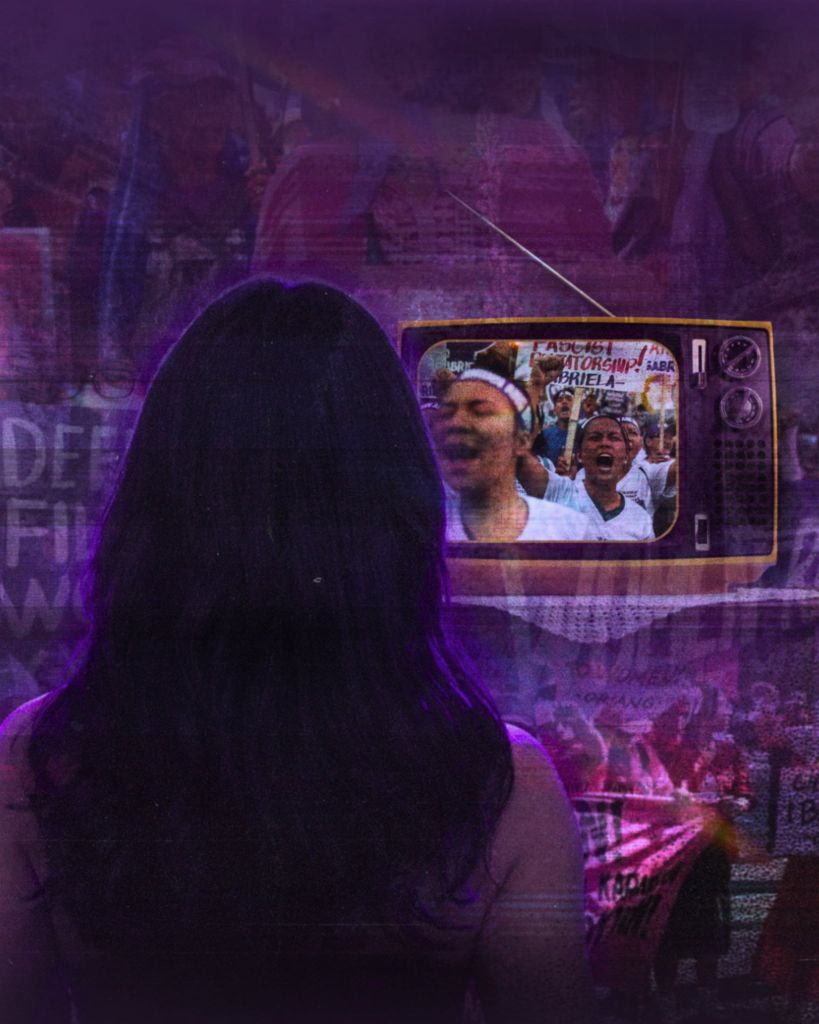
Do you think the cracked pavements of the EDSA streets remember the footsteps of those who marched on them long ago?

Fifty-three years have passed since Proclamation No. 1081 – Marcos Sr.’s Martial Law – and yet the rain falls as if to remind us that the ground is still soaked in the blood and fear of those years. Over the span of a little less than 14 years, an estimated 70,000 of the Marcoses’ political enemies were imprisoned and over 3,200 found themselves deprived of a peaceful departure, all under the dictatorial powers of Ferdinand Marcos Sr. ‘s regime. But it seems that numbers cannot hold the shriek of a mother who never found her son nor catch the rattle of a typewriter seized from a silenced newspaper office. They cannot explain how the family that the Filipino people took decades to repel was able to return in power and be greeted with open arms by descendants of the people who resisted them in the first place.

However, in spite of many history books that deem the martial law era as the country’s “golden age”, the Marcoses fail to understand that history does not like to be twisted, and it will not favor those who attempt to wring it of truth. This Sunday, the ghosts return, not as a whisper of a digital material posted online, but as footsteps once more. Two of them, in fact: Baha sa Luneta: Aksyon na Laban sa Korapsyon at nine in the morning, and the Trillion-Peso March at EDSA by mid-afternoon. Supported by at least 200 organizations composed of church groups, student organizations and labor unions, the rally shows signs of great promise for active reform within the government.

This time, they will come not in yellow, the color on our flag that’s supposed to symbolize freedom, democracy and sovereignty, nor will it be red, the supposed color of patriotism and the willingness of the Filipino to shed blood for the country. No, they will come in black, the color of defiance, sorrow and anger. One could not help but to think of how sick and tired we are of the streets to be painted in the literal absence of color. Like we are absolutely drained– of our time, sweat and resources– by those of the privileged and in power.

President Ferdinand Marcos Jr. now sits on the same mountain of rot that has weighed on this country for decades. He may bark “Mahiya naman kayo [You should be ashamed]” to perfume himself with the scent of justice that the Filipinos yearn to grasp, but shaming the corrupt does not make heads turn away from glaring back at him. The investigations into ghost projects and phantom flood walls only flared when he ordered them, which makes you wonder if these “discoveries” are anything more than old favors finally falling out of fashion, or if the ghosts were already feeding the very politicians now pretending to hunt them.

The symmetry is brutal. In 1972, Martial Law was justified as a way to keep order; today, corruption in flood control and public works is excused as “just politics.” Then and now, power collects in a few hands while ordinary Filipinos drown—sometimes in cellars, sometimes in knee-deep street water. Forgetting is the bridge between those two eras. Forgetting is the permission slip. Forgetting is why another Marcos can look the camera dead in the eye and tell the public to be ashamed, as though the shame were ours.

To the Marcos administration, I would like to commend you for at least attempting to reframe the indignity and shame that must come with corruption; though I have no clue of what is to happen when the Filipino inevitably choose to take matters into their own hands–as it should have been. And though it may look like they have gained the public’s trust, history has always proven itself cyclical; and should a spark inevitably be ignited, as with other nations that refused to endure empty promises, it is impossible to know whose heads will roll.

Recently, the world has seen a fallen government in Nepal, a weakened parliament in France, and a gruesome chain of protests in Indonesia. In the age of social media, we have been privileged to witness secondhand how the people of these nations have stood their ground, reclaiming the power that was meant to be theirs from the beginning, power once betrothed to their leaders but betrayed in its keeping. And now, as the Filipino people attempt to follow this path, it becomes a formidable reminder that, while some have forgotten, there are still many who refuse to succumb to the outbreak of controlled dementia that numbs only the memory of cruelty and tyranny.

The tyrants’ attempts to remove their bloodstained legacy from our nation’s history will never cease; but as long as the people cry “never again,” they can never be raised upon the pedestal of saints. So when you see the black tide of protest moving through Luneta and along EDSA, do not look away. Do not comfort yourself with the lie that this is just another weekend rally, just another bout of bad weather. Look into the flood and you will see a mirror: the soldiers who raided homes in 1972, the billions siphoned off in 2025, the same families fattening on taxes while warning us not to make trouble.

Be angry. Be unafraid of that anger. Let it move through you like a current through a live wire. Anger is a memory refusing to die. Anger is the sound of doors not yet kicked in, of a people who still remember the taste of freedom. March if you can and speak if you cannot march. Refuse the slow drowning of silence. Because the cycle ends only when we end it. “Never again” is not a phrase uttered by legends in history books; it is a command for the living, and it is up to us whether or not we choose to immortalize the memories of our ancestors before they are forgotten. Only then can history never be forgotten ever and again.

Who Gets to Sail

By Jazie Rangga || Illustration by Jen Abasola

“And God looked upon the earth, and, behold, it was corrupt.”

These words, drawn from ancient scripture, echo in a modern Philippines where every storm exposes the rot. When the rains come, rivers overflow, roads transform into canals, and lives are once again paused because the State has failed to deliver what was promised. Yet, on glowing phone screens, another kind of flood surges forth — a flood of excess, of wealth so casually flaunted that it mocks the suffering outside.

This is not wealth born of innovation or industry. It is wealth siphoned from contracts signed in the people’s name, from taxes scraped off their paychecks, from flood control projects that failed to hold back the waters. And at the center of this scandal stands not only Claudine Co, with her surplus of paid happiness, but the dynasty that enables her indulgence: her father, former Ako Bicol Rep. Christopher Co and uncle, Albay Rep. Elizaldy “Zaldy” Co. Businessmen turned politicians, whose construction business entitled them to become one of the supercontractors for the Department of Public Works and Highway (DPWH).

These men are not strangers to the public purse. The public was promised safety from swollen rivers and submerged neighborhoods, yet what came instead were unfinished projects, recycled allocations, and suspiciously repeated bidding patterns. And while the waters continued to rise, what rose alongside them were images on social media — snapshots of luxury handbags, private jets, and shopping trips abroad, symbols of excess seemingly built on the very projects that failed the people. Claudine Co’s life of ease plays out in high-definition on TikTok and Instagram, a silent indictment of promises unkept.

The backlash was swift. Every image of a G-Wagon, every Instagram reel of a private flight became a mirror of the suffering of Filipinos left to swim through broken systems. The anger was not directed only at one woman but at what she symbolized: the unholy marriage of public money and private indulgence.

But the Ark of privilege has room for many. Sarah Dicaya, Gela Alonte, Jammy Cruz, Mark Allen Arevalo — companions, fellow influencers and other tasked contractors — appear in the same orbit, sharing in the spectacle of indulgence. Their images, too, become symbols of a deeper truth: while the poor are left clinging to rooftops during storms, the well-connected float together, insulated, immune.

This is not new. One cannot help but remember how the Marcoses, whose ill-gotten wealth is still being litigated decades after Martial Law, once threw lavish parties in Malacañang while Filipinos lined up for rice during an economic collapse. How Joseph Estrada built his mansions and stashed millions in bank accounts while claiming to be a “man of the masses.” How the Revillas became poster children of the pork barrel scam, with Janet Napoles orchestrating ghost projects while senators smiled for cameras. How Gloria Macapagal-Arroyo was linked to padded government deals while hospitals lacked basic medicine. The Dutertes, meanwhile, now face Senate scrutiny over confidential funds that vanished into bureaucratic shadows.

The cycle is so entrenched that it has numbed the public. Every scandal becomes “just another.” Every revelation is met with a shrug. This resignation is perhaps the most dangerous consequence of all. When betrayal becomes expected, accountability dies.

Claudine Co’s scandal is different only in its immediacy. Unlike offshore accounts and shadowy Senate hearings of past decades, her family’s excess is broadcast in real time, visible to millions. Every post, every story, every video becomes a mirror of Filipino suffering — taxes deducted from paychecks, excise duties on fuel, billions earmarked for flood prevention — all funneled into a lifestyle so alien it feels untouchable.

The anger is righteous. It is not envy nor the crab mentality critics invoke to dismiss public outrage. Ordinary people endure hardship and pay faithfully, yet those tasked with their protection treat public funds as inheritance. Every rainy season exposes betrayal: Marikina residents stacking furniture on second floors, Cavite residents waiting for makeshift boats, Albay farmers losing crops and homes. Billions poured into flood control remain invisible in their protective effect and still, the Co family’s fortune grows.

This pattern is unbroken. Every scandal — Estrada, Revilla, Arroyo, Marcos, Duterte, Co — reinforces the same lesson: public service is a performance, accountability optional, and the people’s trust expendable. Each scandal numbs the citizenry further, until resignation becomes the default. Yet the Claudine Co episode cuts differently because it is personal, immediate, and impossible to ignore. It exposes a fundamental imbalance: those who give everything are the ones left behind, while those born into privilege remain untouchable.

The legal defense that Claudine holds no office is irrelevant. Republic Act 6713, the Code of Conduct for Public Officials, extends moral and ethical expectations to family members, making her proximity to power complicit. To flaunt wealth derived directly or indirectly from government contracts is a violation of public trust, a slap in the face of every Filipino who funds those projects. Investigations, lifestyle checks, and televised hearings cannot erase the deeper truth: the system itself facilitates this betrayal.

The Filipino cannot afford complacency. This is about more than one influencer. It is about whether taxes serve protection or indulgence, whether infrastructure serves the people or dynastic wealth, whether leadership is an obligation or a birthright. Claudine Co’s life of luxury is a lens revealing the nation’s enduring failure: a government that prioritizes the comfort of the few over the survival of the many.

There is a quiet irony in the Bible; that when Noah built the Ark, it was to save the innocent from the flood that washes the world of sin. Today, in the Philippines, the floods still come but it is now the righteous that are left to sink.

Until accountability becomes real, until public projects serve the public, every jet that takes off and every luxury car that rolls out of a gated driveway will remain a reminder of betrayal. Each rainy season, as they let the waters rise again, the nation will only be reminded who truly bears the cost of privilege: the ordinary Filipino. Claudine Co is not just an influencer. She is the gleaming Ark of her dynasty — a vessel for privilege built on the people’s sacrifice. And until that vessel is dismantled, the floods will keep returning, and it will always be the ordinary Filipino who drowns.

Pisay-EVC ends year with Paskorus ‘24

By Claire Orejola || Photo by Poimen Agnila

Philippine Science High School – Eastern Visayas Campus (PSHS-EVC) celebrated Paskorus 2024 with the theme “Maribhong, Marisyo, Malamrag” at the PSHS-EVC gymnasium on December 19, providing the students with the opportunity to showcase their performances and the many hours they had spent practicing for the different contests.

The program started at 8:00 A.M. with a prayer, singing of the National Anthem, and the opening remarks by SSD Chief Dennis A. Juabot.

After Juabot’s speech, a recap video of practice sessions was shown, and the judges were introduced before the contest began.

The year’s Paskoruswas divided into several contests: Straight Singing and Choreographed Singing for Categories A & B, and a Musical Play for Category C.

The contestants, grouped into House X (Minokawa), House Y (Bakunawa), and House Z (Arimaonga), gave their best in their performances, showing great effort in what they had worked hard to create.

After all the performances, certificates were given to the judges, and the winners were announced. 

In Straight Singing Category A, House Z took first place, House X took second, and House Y won third. For Straight Singing Category B, House Z took first, while Houses X and Y took second and third, respectively.

In Choreographed Singing Category A, House X took first place, House Z took second place, and House Y came third. For Choreographed Singing Cat. B, House Z won first place, while Houses X and Y, won second second and third, respectively. 

Meanwhile, in the Musical Play, House Z won first, followed by House X in second, and House Y in third.

“As a freshie, being part of this year’s Paskorus competition was such a memorable experience. Winning with the team made it even more special, and I’m so grateful for the support of our seniors. Their guidance brought out the best in us. Congrats Minokawa!” Samantha Romero, a member of House X which placed 1st in the Choreographed Singing Category A, said.

Paskorus 2024 is an annual event of PSHS-EVC meant to spread holiday cheer and showcase the talents of scholars.

Kanlaon eruption displaces thousands

By Josh Aseo || Photo by Inquirer.net

Over 87,000 civilians were displaced after the eruption of Mount Kanlaon in the Negros Islands at approximately 3:03 p.m. on December 9, 2024.

The eruption produced a voluminous plume that rapidly rose to 3,000 meters above the vent and drifted west-southwest. Pyroclastic density currents or PDCs descended the slopes on the general southeastern edifice based on IP and thermal camera monitors,” said the Philippine Institute of Volcanology and Seismology (PHIVOLCS).

PHIVOLCS later issued an evacuation warning to civilians living within a 6 km radius of the volcano’s summit and warned of the possible continued eruption in the coming days.

In a follow-up statement on December 10, the Office of Civil Defense reported the successful evacuation of 2,880 families, or around 9,400 individuals from the municipalities of Bago, Pontevedra, La Castellana, and La Carlota.

PHIVOLCS raised the alert level of Kanlaon from Level 1 to Level 2 on June 3 due to an explosive eruption in the summit vent resulting in the evacuation of 4,752 individuals and a damage of over ₱151 million to the agriculture sector. The alert level was then raised to Level 3 after the eruption on December 9.

The latest eruption made history as the first ever magmatic eruption in over 100 years with the last recorded magmatic eruption happening in 1902.

They’re Human Too

By Zachary Tan || Graphics by Elijah Hembra

It’s 7 PM. I’ve just been reminded that my group has got a Social Science presentation tomorrow on the Cold War, and zero progress has been made. So, in a fit of dire necessity, I boot up YouTube and rewatch the Oversimplified video on it to get a feel for what to even put in the rushed PowerPoint our group is making. Yet, the next day, after a few words on the Iron Curtain and some criticism of the Soviet economy, the presentation finishes rather smoothly. Once again, pop history comes to my rescue.

In one way or another, pop history, or historiography aimed at the general public, has most definitely influenced not only people’s understanding of our past but has seeped its way into our education systems to both its benefit and detriment as we can see from landmark events to motivational heroes. 

It is undoubted that pop history is a perfect entrypoint to further your understanding and appreciation for all that has come before us to mold our world into what it is today. The creation of pop history for widespread understanding is in of itself a skill to boil down complicated matters into simple concepts without ignoring the nuance of it all. When it’s done well, pop history can be the pinnacle of ‘edutainment’ as I myself can attest to. 

During the pandemic, I entered the rabbit hole of history YouTube and discovered wondrous creators such as that of Historia Civilis which managed to hook me into a story from millenia ago while not compromising historical integrity. However, with each Historia Civilis, there lies tens more which are unable to meet the important need for truth and nuance in pop history. This is as one of the great perils in pop history lies in the fact that it compiles the past into neat boxes with clear delineations to create a clean and simple story for the general public. However, real life is far more complicated than a simple black and white or good and bad. This is true even with our national heroes, Jose Rizal and Andrés Bonifacio, the faces transcending time from our statues to our currency.

When we think of Rizal and Bonifacio, they often feel like they are diametrically opposed. Rizal comes from the rich ilustrado class wherein he was educated in the best schools the Philippines had to offer and used the power of the pen to push for the Philippines’ autonomy. Meanwhile, Bonifacio was born working class, unable to finish formal education, and helped found the Katipunan, the foremost armed force in fighting for an independent Philippines. The only thing uniting these two men were their love for their country and their hope for a better Philippines. 

These are the ideas cemented into our minds from when we were young through the media we consume and even occasionally our schools. This is as we often get tunnel visioned into these figures’ ‘greatest contributions’ while ignoring the fact that they are multifaceted human beings. Rizal, as much as he was an advocate for nonviolent resistance, was a pragmatic individual. With this, according to accounts from his time such as that of Pio Valenzuela, nearing the end of his life, Rizal believed that assuming no other means were viable and the resistance was ready enough, a violent revolution would be favorable. On the other hand, Bonifacio was by no means some sort of brutal warmonger only out for Spanish heads. Rather, he had even been a member of Rizal’s own reformist organization La Liga Filipina which aimed to push for internal change within the Philippines under Spanish rule.

However, despite this seemingly glaring gray area with their respective beliefs, both these great men have generally been reduced to simple pacifism or violence. I myself find it difficult to remember a time in which I was taught anything more complicated about their lives beyond their simple attributes and somewhat irrelevant fun facts. In fact, this does not only just apply to Rizal and Bonifacio, but a whole host of other people, events, and entire eras when the topic is as complicated as history is. However, this issue does not necessarily come from our educators, it is a matter of how we as a whole approach the idea of teaching history and the usage of pop history. 

We already know in our daily lives that people or rather the human experience as a whole is such a complicated subject with multiple sides and complicated moralities. Why can we not extend this to those who have come before, the somewhat deified figures of our past still remain to be people after all, no matter how dead they may be. Engaging stories and nuance under pop history are not mutually exclusive. Oftentimes, the most engaging stories are those containing fully fleshed out characters without clear lines of evil and good, and history is no exception. This is why the utmost care must be taken when speaking about these complicated issues and larger-than-life individuals which affect who we are today. After all, these names on our textbooks had personalities, hopes, and loved ones as well like all human beings do.

Victory in Full Stroke

By Anthony Urmeneta || Graphics by Akhou Uribe

In a thrilling finale at the 2024 International Canoe Federation Dragon Boat World Championships, Sherylou Vermug, a paddler from Tacloban City, along with the Philippine team blasted through the competition, paddling past Canada to cap a first-place finish in the Master 40+ Women’s 2000m race at Puerto Princesa Baywalk on November 3, 2024. 

“The most memorable part was when we raced the 2000m category,” said Vermug, reflecting on the high-stakes race. “It’s my first time to race such a long distance, it was intense, and we got gold.”

The athlete got her start in dragon boat racing in 2018, when a college friend invited her to join the Waraybugsay Dragon Boat crew. Nearly five years later, she has become a key member of the team.

For her, the key to success in the sport lies in teamwork and mutual support among the athletes. “Dragon boat is a team sport,” she said. “We encourage one another to reach our full potential during the competition and always give our best.”

The 2000-meter race, held on the final day of competition, pushed both Vermug and her team to their physical and mental limits, but they stayed focused and crossed the finish line together.

The victory was palpable for the dragon boat racer, who wasted no time in expressing her gratitude to those who made it possible. “Of course, I am always thankful to God Almighty for the strength and good health. To my family, for their full support, understanding, and love. Our coach, Ronald Tan, who shares his knowledge with us, believes in us, and pushes us to do our best during training and in the competition. Walang Hanggang Pasasalamat, Coach.”

The success of their team highlights a growing interest in the sport, both locally and beyond. With dragon boat racing on the rise, Vermug hopes more young people will be inspired to join, seeing it as a way to build strength and forge lasting friendships.

“As a paddler, I am very happy to see that dragon boat racing is starting to gain popularity in our community,” the athlete shared. “It would help a lot if youngsters find an interest in the sport. It can build strength, boost confidence, and help them make more friends at the same time.”

As for Vermug, this victory is just the beginning. Looking to the future, she is focused on continuing her personal growth and pushing her team toward even greater success. “Many races will come in the future, but not all will be victorious,” she said. “So continue to train properly and never think you’re better than your teammates, because everyone is important in the boat.”