
By Poimen Agnila || Illustration by Lilianne Salorio
The downfall of a nation lies in its short memory.
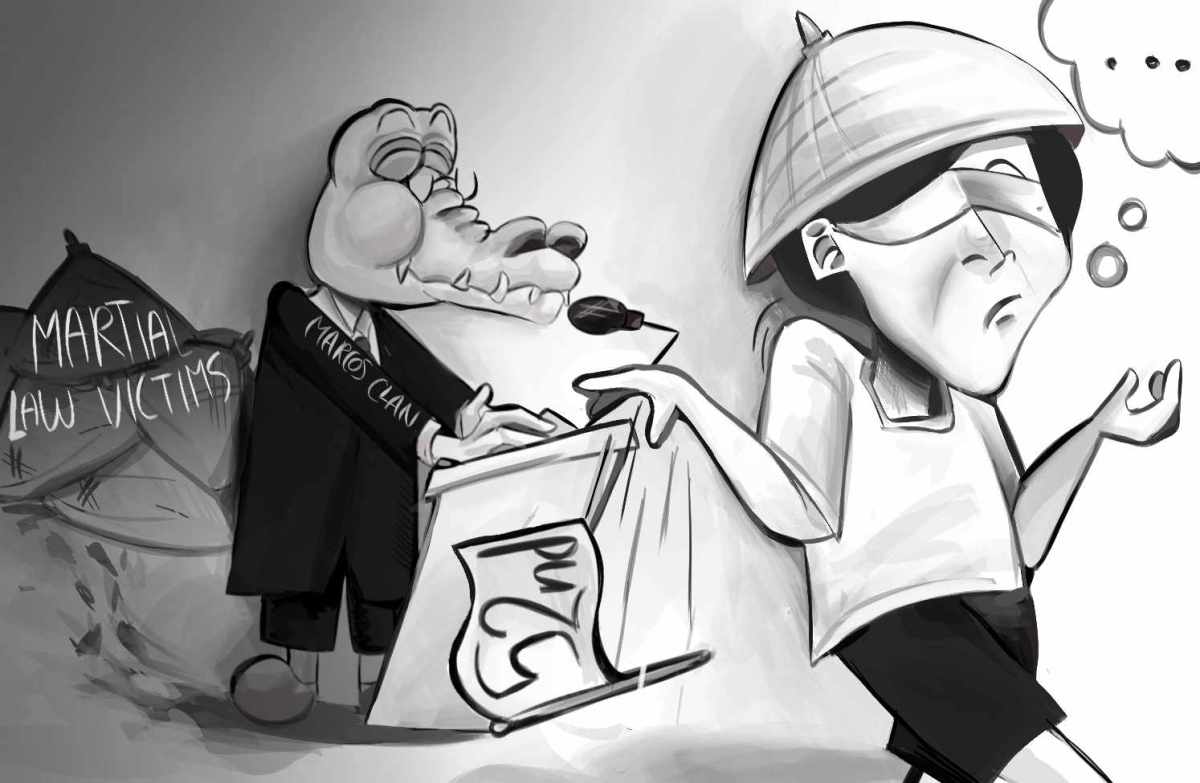
Whether it be because of the perpetuation of a golden era narrative, the antagonizing of progressive ideology, or the non-acknowledgment of the barbarism caused by the past regime, the current state of this country’s democracy hinges strongly on the people’s collective capacity to remember.
September 21st marks the 52nd anniversary of the signing of Proclamation No. 1081—the beginning of Ferdinand Marcos Sr.’s authoritarian reign over what he described as a country in peril. Threatened by communist movements gaining traction in the Philippines, Marcos sought to “save the republic and reform society” through the declaration of martial law. What would follow was 14 years of violence, forced silence, and infamous kleptocracy.
In the wake of Bongbong Marcos’ candidacy and his family’s rise to mainstream relevance once more, a sickness seems to have gripped the nation—forgetfulness. Seemingly losing all memory of the family’s misdeeds, the Filipino masses have elected another Marcos to power, despite questionable claims of achievements and streaks of disinformation painting his reputation as a politician.
His subsequent appointment as president allowed him to reframe the country’s view of his family and their wrongdoings, wiping away a bloodied history rife with torture and abuse endured by those whose only crime was resistance.
As we witness history being revised in real-time, we face the important question of what it truly means to never forget.
In times like these, it is imperative to question the validity of claims rather than simply accepting the information given to us. In a subject matter with as wide-ranging consequences as politics, being critical and holding those in power accountable are the first steps to rebuilding a memory actively being erased.
There never was a “golden era”.
What the Marcos clan claimed was a prosperous period in the nation’s history was in truth only applicable to them, having appropriated billions of pesos from the country’s funds. In July 2003, the Supreme Court allowed for the forfeiture of the Marcoses’ $683 million in funds, deposited in Switzerland through questionable Swiss foundations. In 2018, the anti-graft court Sandiganbayan found former First Lady Imelda Marcos guilty of 7 counts of graft related to the aforementioned plunder.
Moreover, the “discipline” and “order” of the martial law era, which was and still is praised for, were the result of censorship and tyranny. Life was only “peaceful” back then because those who dared to speak up against the regime’s crimes were silenced forever. Journalists and activists who opposed government decisions were tracked down, arrested, and forced to keep shut. In more severe cases, they were brutally tortured and even killed. Data from Amnesty International (as cited in The Martial Law Chronicles Project) reports that 70,000 people were imprisoned, 34,000 were tortured, and 3,240 were killed during Marcos Sr.’s reign of terror.
It is undeniable that the declaration of Proclamation No. 1081 paved the way for the late dictator’s authoritarian regime. And as history repeats itself with the election of his son to office, we must also reminisce, along with the facts we are armed with, of the power collective resistance holds.
There is a reason why the EDSA People Power Revolution succeeded in ousting Marcos. It was the refusal to forget by the thousands who filled EDSA that fateful series of days in 1986 that led us to the freedom we now enjoy. Whether or not we continue the example they have set will determine if this country will live to see a different era of governance.
In the film adaptation of F.H. Bacatan’s book, Smaller and Smaller Circles, Father Jerome Lucero imparts to his students a valuable lesson on the Martial Law era: “Time and forgetfulness are the allies of abusers.”
We hold in our hands the power to end revisionist narratives. As citizens, our duty to remember extends beyond just a simple recollection of what happened; it also directs us to fight against attempts to rewrite history. Learn from the past. Engage in discourse. Become a voice for truth. There is no greater antidote to forgetfulness than a mind that keeps remembering.
The downfall of a nation lies in its short memory but its revival hinges on its people’s capacity to remember.
 the-science-net.com